'%3e%3crect%20width='52'%20height='40'%20rx='10'%20fill='%23FFEA96'/%3e%3cg%20clip-path='url(%23clip1_2569_1375)'%3e%3crect%20width='59.0741'%20height='44'%20transform='translate(-3%20-4)'%20fill='%23A4ECF6'/%3e%3cg%20filter='url(%23filter0_f_2569_1375)'%3e%3cellipse%20cx='-10.3274'%20cy='7.80296'%20rx='36.4924'%20ry='39.2338'%20transform='rotate(11.6674%20-10.3274%207.80296)'%20fill='%23DDE2FF'/%3e%3cellipse%20cx='-10.3274'%20cy='7.80296'%20rx='36.4924'%20ry='39.2338'%20transform='rotate(11.6674%20-10.3274%207.80296)'%20stroke='%238FA6EB'%20stroke-width='21.4144'/%3e%3c/g%3e%3c/g%3e%3cpath%20d='M15.5%2029.3333L17.0167%2024.7833C14.3053%2020.7735%2015.353%2015.5993%2019.4667%2012.6803C23.5803%209.7625%2029.4883%2010.0017%2033.2858%2013.2403C37.0833%2016.4802%2037.5967%2021.7173%2034.4863%2025.4915C31.376%2029.2657%2025.6022%2030.409%2020.9833%2028.1667L15.5%2029.3333Z'%20stroke='white'%20stroke-width='1.5'%20stroke-linecap='round'%20stroke-linejoin='round'/%3e%3c/g%3e%3cdefs%3e%3cfilter%20id='filter0_f_2569_1375'%20x='-78.1925'%20y='-62.604'%20width='135.73'%20height='140.814'%20filterUnits='userSpaceOnUse'%20color-interpolation-filters='sRGB'%3e%3cfeFlood%20flood-opacity='0'%20result='BackgroundImageFix'/%3e%3cfeBlend%20mode='normal'%20in='SourceGraphic'%20in2='BackgroundImageFix'%20result='shape'/%3e%3cfeGaussianBlur%20stdDeviation='10.2764'%20result='effect1_foregroundBlur_2569_1375'/%3e%3c/filter%3e%3cclipPath%20id='clip0_2569_1375'%3e%3crect%20width='52'%20height='40'%20rx='10'%20fill='white'/%3e%3c/clipPath%3e%3cclipPath%20id='clip1_2569_1375'%3e%3crect%20width='59.0741'%20height='44'%20fill='white'%20transform='translate(-3%20-4)'/%3e%3c/clipPath%3e%3c/defs%3e%3c/svg%3e)
'%3e%3crect%20width='52'%20height='40'%20rx='10'%20fill='%23FFEA96'/%3e%3cg%20clip-path='url(%23clip1_2569_15019)'%3e%3crect%20width='84'%20height='42'%20transform='translate(-2%20-1)'%20fill='%2379BB84'/%3e%3cg%20filter='url(%23filter0_f_2569_15019)'%3e%3cellipse%20cx='51.2293'%20cy='24.9396'%20rx='37.103'%20ry='27.6663'%20transform='rotate(140.546%2051.2293%2024.9396)'%20fill='%2375D0AA'/%3e%3cellipse%20cx='51.2293'%20cy='24.9396'%20rx='37.103'%20ry='27.6663'%20transform='rotate(140.546%2051.2293%2024.9396)'%20stroke='%23A5E5AB'%20stroke-width='26'/%3e%3c/g%3e%3c/g%3e%3cpath%20d='M15.5%2017.6667H36.5M23.6667%209.5V30.5M15.5%2011.8333C15.5%2011.2145%2015.7458%2010.621%2016.1834%2010.1834C16.621%209.74583%2017.2145%209.5%2017.8333%209.5H34.1667C34.7855%209.5%2035.379%209.74583%2035.8166%2010.1834C36.2542%2010.621%2036.5%2011.2145%2036.5%2011.8333V28.1667C36.5%2028.7855%2036.2542%2029.379%2035.8166%2029.8166C35.379%2030.2542%2034.7855%2030.5%2034.1667%2030.5H17.8333C17.2145%2030.5%2016.621%2030.2542%2016.1834%2029.8166C15.7458%2029.379%2015.5%2028.7855%2015.5%2028.1667V11.8333Z'%20stroke='white'%20stroke-width='1.5'%20stroke-linecap='round'%20stroke-linejoin='round'/%3e%3c/g%3e%3cdefs%3e%3cfilter%20id='filter0_f_2569_15019'%20x='-8.68196'%20y='-33.1753'%20width='119.823'%20height='116.23'%20filterUnits='userSpaceOnUse'%20color-interpolation-filters='sRGB'%3e%3cfeFlood%20flood-opacity='0'%20result='BackgroundImageFix'/%3e%3cfeBlend%20mode='normal'%20in='SourceGraphic'%20in2='BackgroundImageFix'%20result='shape'/%3e%3cfeGaussianBlur%20stdDeviation='6.65'%20result='effect1_foregroundBlur_2569_15019'/%3e%3c/filter%3e%3cclipPath%20id='clip0_2569_15019'%3e%3crect%20width='52'%20height='40'%20rx='10'%20fill='white'/%3e%3c/clipPath%3e%3cclipPath%20id='clip1_2569_15019'%3e%3crect%20width='84'%20height='42'%20fill='white'%20transform='translate(-2%20-1)'/%3e%3c/clipPath%3e%3c/defs%3e%3c/svg%3e)
'%3e%3crect%20width='52'%20height='40'%20rx='10'%20fill='%23FFEA96'/%3e%3cg%20clip-path='url(%23clip1_2569_362)'%3e%3crect%20width='80'%20height='40'%20fill='%23D79BA2'/%3e%3cg%20filter='url(%23filter0_f_2569_362)'%3e%3cellipse%20cx='88.9522'%20cy='26.2192'%20rx='52.3951'%20ry='72.8474'%20transform='rotate(36.0726%2088.9522%2026.2192)'%20fill='%23B6CDEA'/%3e%3cellipse%20cx='88.9522'%20cy='26.2192'%20rx='52.3951'%20ry='72.8474'%20transform='rotate(36.0726%2088.9522%2026.2192)'%20stroke='%23829BB8'%20stroke-width='27'/%3e%3c/g%3e%3c/g%3e%3cpath%20d='M29.5%209.5V14.1667C29.5%2014.4761%2029.6229%2014.7728%2029.8417%2014.9916C30.0605%2015.2104%2030.3572%2015.3333%2030.6666%2015.3333H35.3333M35.3333%2015.3333L29.5%209.5H24.8333C24.2145%209.5%2023.621%209.74583%2023.1834%2010.1834C22.7458%2010.621%2022.5%2011.2145%2022.5%2011.8333V23.5C22.5%2024.1188%2022.7458%2024.7123%2023.1834%2025.1499C23.621%2025.5875%2024.2145%2025.8333%2024.8333%2025.8333H33C33.6188%2025.8333%2034.2123%2025.5875%2034.6499%2025.1499C35.0875%2024.7123%2035.3333%2024.1188%2035.3333%2023.5V15.3333ZM30.6666%2025.8333V28.1667C30.6666%2028.7855%2030.4208%2029.379%2029.9832%2029.8166C29.5456%2030.2542%2028.9522%2030.5%2028.3333%2030.5H20.1666C19.5478%2030.5%2018.9543%2030.2542%2018.5167%2029.8166C18.0791%2029.379%2017.8333%2028.7855%2017.8333%2028.1667V16.5C17.8333%2015.8812%2018.0791%2015.2877%2018.5167%2014.8501C18.9543%2014.4125%2019.5478%2014.1667%2020.1666%2014.1667H22.5'%20stroke='white'%20stroke-width='1.5'%20stroke-linecap='round'%20stroke-linejoin='round'/%3e%3c/g%3e%3cdefs%3e%3cfilter%20id='filter0_f_2569_362'%20x='-15.6247'%20y='-84.562'%20width='209.154'%20height='221.562'%20filterUnits='userSpaceOnUse'%20color-interpolation-filters='sRGB'%3e%3cfeFlood%20flood-opacity='0'%20result='BackgroundImageFix'/%3e%3cfeBlend%20mode='normal'%20in='SourceGraphic'%20in2='BackgroundImageFix'%20result='shape'/%3e%3cfeGaussianBlur%20stdDeviation='15.4'%20result='effect1_foregroundBlur_2569_362'/%3e%3c/filter%3e%3cclipPath%20id='clip0_2569_362'%3e%3crect%20width='52'%20height='40'%20rx='10'%20fill='white'/%3e%3c/clipPath%3e%3cclipPath%20id='clip1_2569_362'%3e%3crect%20width='80'%20height='40'%20fill='white'/%3e%3c/clipPath%3e%3c/defs%3e%3c/svg%3e)
'%3e%3crect%20width='52'%20height='40'%20rx='10'%20fill='%23FFEA96'/%3e%3cg%20clip-path='url(%23clip1_2569_6710)'%3e%3crect%20width='80'%20height='40'%20transform='translate(-15)'%20fill='%233D8E9C'/%3e%3cg%20filter='url(%23filter0_f_2569_6710)'%3e%3cellipse%20cx='32.2505'%20cy='16.4558'%20rx='51.5307'%20ry='23.1466'%20transform='rotate(50.2591%2032.2505%2016.4558)'%20fill='%2364E7DE'/%3e%3cpath%20d='M44.5377%206.2394C53.1416%2016.5878%2058.8151%2027.267%2061.2268%2035.9325C63.8373%2045.3129%2062.0035%2049.4129%2060.6132%2050.5689C59.2229%2051.7249%2054.8566%2052.7803%2046.11%2048.501C38.0303%2044.548%2028.5662%2037.0204%2019.9623%2026.672C11.3585%2016.3236%205.68548%205.64501%203.27384%20-3.02044C0.663075%20-12.4014%202.49786%20-16.5016%203.88815%20-17.6575C5.27854%20-18.8134%209.64428%20-19.868%2018.3906%20-15.5889C26.4702%20-11.6359%2035.9338%20-4.10886%2044.5377%206.2394Z'%20stroke='%234ECDC4'%20stroke-width='14.3333'/%3e%3c/g%3e%3c/g%3e%3cpath%20d='M20.1667%2029.3333H31.8333M19%2013L26%2011.8333L33%2013M19%2013L22.5%2020C22.5%2020.9283%2022.1313%2021.8185%2021.4749%2022.4749C20.8185%2023.1313%2019.9283%2023.5%2019%2023.5C18.0717%2023.5%2017.1815%2023.1313%2016.5251%2022.4749C15.8687%2021.8185%2015.5%2020.9283%2015.5%2020L19%2013ZM33%2013L36.5%2020C36.5%2020.9283%2036.1313%2021.8185%2035.4749%2022.4749C34.8185%2023.1313%2033.9283%2023.5%2033%2023.5C32.0717%2023.5%2031.1815%2023.1313%2030.5251%2022.4749C29.8687%2021.8185%2029.5%2020.9283%2029.5%2020L33%2013ZM26%209.5V29.3333'%20stroke='white'%20stroke-width='1.5'%20stroke-linecap='round'%20stroke-linejoin='round'/%3e%3c/g%3e%3cdefs%3e%3cfilter%20id='filter0_f_2569_6710'%20x='-18.2683'%20y='-38.9196'%20width='101.038'%20height='110.751'%20filterUnits='userSpaceOnUse'%20color-interpolation-filters='sRGB'%3e%3cfeFlood%20flood-opacity='0'%20result='BackgroundImageFix'/%3e%3cfeBlend%20mode='normal'%20in='SourceGraphic'%20in2='BackgroundImageFix'%20result='shape'/%3e%3cfeGaussianBlur%20stdDeviation='6.53333'%20result='effect1_foregroundBlur_2569_6710'/%3e%3c/filter%3e%3cclipPath%20id='clip0_2569_6710'%3e%3crect%20width='52'%20height='40'%20rx='10'%20fill='white'/%3e%3c/clipPath%3e%3cclipPath%20id='clip1_2569_6710'%3e%3crect%20width='80'%20height='40'%20fill='white'%20transform='translate(-15)'/%3e%3c/clipPath%3e%3c/defs%3e%3c/svg%3e)
'%3e%3crect%20width='52'%20height='40'%20rx='10'%20fill='%23FFEA96'/%3e%3cg%20clip-path='url(%23clip1_2569_4656)'%3e%3crect%20width='100'%20height='50'%20transform='translate(-24%20-4)'%20fill='%238D8DCF'/%3e%3cg%20filter='url(%23filter0_f_2569_4656)'%3e%3cellipse%20cx='16.4735'%20cy='40.123'%20rx='70.3864'%20ry='33.942'%20transform='rotate(-179.853%2016.4735%2040.123)'%20fill='%23D6C6FF'/%3e%3cpath%20d='M16.4056%2066.4097C-2.13768%2066.3619%20-18.5399%2062.679%20-30.016%2057.1085C-42.0318%2051.276%20-46.2693%2044.7259%20-46.2571%2039.9612C-46.2446%2035.1965%20-41.9732%2028.6691%20-29.9279%2022.8987C-18.4234%2017.3873%20-2.00237%2013.7889%2016.5409%2013.8366C35.084%2013.8843%2051.4863%2017.5673%2062.9624%2023.1377C74.978%2028.9701%2079.2165%2035.5194%2079.2045%2040.2841C79.1922%2045.0488%2074.9201%2051.577%2062.8743%2057.3476C51.3697%2062.8588%2034.9487%2066.4574%2016.4056%2066.4097Z'%20stroke='%239B89EE'%20stroke-width='15.311'/%3e%3c/g%3e%3c/g%3e%3cpath%20d='M28.3333%209.5V14.1667C28.3333%2014.4761%2028.4563%2014.7728%2028.6751%2014.9916C28.8938%2015.2104%2029.1906%2015.3333%2029.5%2015.3333H34.1667M34.1667%2020V15.3333L28.3333%209.5H20.1667C19.5478%209.5%2018.9543%209.74583%2018.5168%2010.1834C18.0792%2010.621%2017.8333%2011.2145%2017.8333%2011.8333V20M17.8333%2027H19.5833C20.0475%2027%2020.4926%2026.8156%2020.8208%2026.4874C21.149%2026.1592%2021.3333%2025.7141%2021.3333%2025.25C21.3333%2024.7859%2021.149%2024.3408%2020.8208%2024.0126C20.4926%2023.6844%2020.0475%2023.5%2019.5833%2023.5H17.8333V30.5M31.8333%2027H34.1667M35.3333%2023.5H31.8333V30.5M24.8333%2023.5V30.5H26C26.6188%2030.5%2027.2123%2030.2542%2027.6499%2029.8166C28.0875%2029.379%2028.3333%2028.7855%2028.3333%2028.1667V25.8333C28.3333%2025.2145%2028.0875%2024.621%2027.6499%2024.1834C27.2123%2023.7458%2026.6188%2023.5%2026%2023.5H24.8333Z'%20stroke='white'%20stroke-width='1.5'%20stroke-linecap='round'%20stroke-linejoin='round'/%3e%3c/g%3e%3cdefs%3e%3cfilter%20id='filter0_f_2569_4656'%20x='-70.246'%20y='-10.1527'%20width='173.439'%20height='100.551'%20filterUnits='userSpaceOnUse'%20color-interpolation-filters='sRGB'%3e%3cfeFlood%20flood-opacity='0'%20result='BackgroundImageFix'/%3e%3cfeBlend%20mode='normal'%20in='SourceGraphic'%20in2='BackgroundImageFix'%20result='shape'/%3e%3cfeGaussianBlur%20stdDeviation='8.16667'%20result='effect1_foregroundBlur_2569_4656'/%3e%3c/filter%3e%3cclipPath%20id='clip0_2569_4656'%3e%3crect%20width='52'%20height='40'%20rx='10'%20fill='white'/%3e%3c/clipPath%3e%3cclipPath%20id='clip1_2569_4656'%3e%3crect%20width='100'%20height='50'%20fill='white'%20transform='translate(-24%20-4)'/%3e%3c/clipPath%3e%3c/defs%3e%3c/svg%3e)
'%3e%3crect%20width='52'%20height='40'%20rx='10'%20fill='%23FFEA96'/%3e%3cg%20clip-path='url(%23clip1_2569_4888)'%3e%3crect%20width='100'%20height='50'%20transform='translate(-24%20-4)'%20fill='%2386568A'/%3e%3cg%20filter='url(%23filter0_f_2569_4888)'%3e%3cellipse%20cx='22.6407'%20cy='24.5662'%20rx='70.3864'%20ry='17.9732'%20transform='rotate(-58.3133%2022.6407%2024.5662)'%20fill='%23F3B3F5'/%3e%3cellipse%20cx='22.6407'%20cy='24.5662'%20rx='70.3864'%20ry='17.9732'%20transform='rotate(-58.3133%2022.6407%2024.5662)'%20stroke='%23B97ACE'%20stroke-width='13'/%3e%3c/g%3e%3c/g%3e%3cpath%20d='M27.1667%209.5V17.6667H34.1667L24.8333%2030.5V22.3333H17.8333L27.1667%209.5Z'%20stroke='white'%20stroke-width='1.5'%20stroke-linecap='round'%20stroke-linejoin='round'/%3e%3c/g%3e%3cdefs%3e%3cfilter%20id='filter0_f_2569_4888'%20x='-38.5803'%20y='-57.283'%20width='122.442'%20height='163.698'%20filterUnits='userSpaceOnUse'%20color-interpolation-filters='sRGB'%3e%3cfeFlood%20flood-opacity='0'%20result='BackgroundImageFix'/%3e%3cfeBlend%20mode='normal'%20in='SourceGraphic'%20in2='BackgroundImageFix'%20result='shape'/%3e%3cfeGaussianBlur%20stdDeviation='7.35'%20result='effect1_foregroundBlur_2569_4888'/%3e%3c/filter%3e%3cclipPath%20id='clip0_2569_4888'%3e%3crect%20width='52'%20height='40'%20rx='10'%20fill='white'/%3e%3c/clipPath%3e%3cclipPath%20id='clip1_2569_4888'%3e%3crect%20width='100'%20height='50'%20fill='white'%20transform='translate(-24%20-4)'/%3e%3c/clipPath%3e%3c/defs%3e%3c/svg%3e)




Law firm software: complete guide and comparison
Which law firm software should you choose?
An objective comparison of the available solutions:
pricing, features and pitfalls to avoid.
With 83% of legal departments expecting their workload to increase in the short and medium term (CLOC, State of the Industry Report 2025), contract review has become a critical issue for companies, law firms and public organisations.
In other words: software-assisted contract review is no longer an innovation, but a **strategic function **for limiting risks, speeding up negotiations and securing legal commitments.
Why is contract review becoming a major issue?
Beyond the growth in contract volumes, legal departments now have to contend with heightened demands for precision, justification and traceability. Every change must be substantiated, every identified risk must be documented, and every inconsistency must be caught very early, tasks that quickly become time-consuming without software assistance.
Against this backdrop, choosing the right tool has become essential. Let’s start by defining precisely what contract review software is.
What is contract review software?
Contract review software is a tool designed to analyse, compare, correct and secure a contract throughout its life cycle.
It is not a simple proofreading tool or a document manager, but a specialised solution capable of:
-
comparing two versions of a contract and detecting sensitive changes;
-
identifying risky contractual patterns (inconsistent definitions, missing clauses…);
-
analysing compliance with internal legal policies;
-
checking references, schedules, cross-references and numbering;
-
automating the review and producing suggestions;
-
facilitating negotiation and validation between stakeholders.
Its role: making proofreading more reliable, reducing human error, speeding up negotiations and strengthening legal certainty.
In practice, these tools rely on artificial intelligence models trained to recognise contractual structures, dependencies between clauses and recurring risk patterns.
AI is not meant to replace in-house counsel, but to assist them by prioritising points of attention, automating checks and securing the review.
In practice,** **an in-house counsel receives a new version of a services agreement ahead of a closing. Within seconds, the software:
-
compares V2 against V1 and highlights that the liability clause has been broadened;
-
spots that the definition of “Confidential Data” no longer matches internal policies;
-
flags the missing technical schedule referred to in article 4;
-
suggests a rewording consistent with the internal template;
-
generates a risk report to share with the operational team.
The result: the review is faster, more reliable, and the legal team secures the negotiation without missing a critical point.
How does contract review software differ from a CLM?
A CLM (Contract Lifecycle Management) tool is software designed to manage the administrative life cycle of contracts: import, creation, storage, approval workflows, collaboration, electronic signature, deadline tracking and archiving.
It effectively structures the contracting processes of legal, procurement, finance and sales departments.
**But its review capabilities are limited. **
A CLM essentially focuses on:
-
track changes;
-
version management;
-
a few standardised templates.
It does not detect:
-
inconsistent definitions;
-
legal errors;
-
omissions that create risk;
-
missing mandatory clauses;
-
structural inconsistencies.
It is not designed to analyse legal reasoning or to suggest contextualised corrections.
A CLM is therefore essential for organising the administrative management of contracts, but it is not enough to deliver a reliable, secure review.
Specialised review software, on the other hand, brings genuine added value: in-depth legal analysis, fine-grained risk detection, precise automated proofreading and an understanding of the contractual context.
In short:
The CLM structures. The review software secures.
The two are complementary, but they do not serve the same purpose.
The essential features of contract review software
To understand what is really expected of review software, you have to start from the daily reality of in-house counsel and business teams: reading quickly, comparing versions, detecting risks and securing approvals.
Behind this requirement, five major needs stand out.
1. Genuine legal analysis, not just enhanced track changes
Professionals are not looking for a tool that proofreads in their place, but an assistant capable of:
-
spotting inconsistencies invisible to the human eye;
-
analysing the contractual logic;
-
detecting omissions, duplications or contradictions;
-
flagging deviations from internal templates;
-
identifying sensitive or missing clauses.
The goal is not simply to monitor the text, but to make the legal reasoning more reliable, while saving considerable time on the points that need attention.
A concrete example: the software can, for instance, detect that a defined term is used without ever being defined, or spot that a liability clause disappeared during an exchange with a supplier, two frequent anomalies that are often hard to catch quickly.
2. Intelligent version comparison
Comparison is at the heart of contract work, but it is time-consuming and a source of human error.
Specialised software must make it possible to:
-
compare two versions line by line or clause by clause;
-
isolate sensitive changes;
-
understand the real impact of deletions or additions;
-
generate a table of discrepancies that can be used in negotiation.
This is no longer a simple redline: it is an analysis of the contract’s evolution, with a focus on risk.
3. Automated detection of contractual risks
Before approving a contract, you need to be certain that nothing has slipped through.
Good review software will flag:
-
inconsistencies between definitions;
-
incorrect cross-references;
-
missing mandatory clauses;
-
structural defects (numbering, schedules, versions);
-
GDPR, security, liability, penalty and insurance risks.
This is what an experienced in-house counsel normally does — but in a few seconds, with no risk of oversight.
4. Smooth collaboration across existing teams and tools
Contracts are never reviewed in isolation: legal, procurement, sales, finance and management are all involved.
The tool must therefore allow:
-
simultaneous work on the same document;
-
coordinated comments;
-
fine-grained change tracking;
-
compatibility with Word, OneDrive, SharePoint, DMS and CLM tools;
-
simple, controlled workflows.
It is not just a checking tool: it is a collaborative working tool.
5. Impeccable security, without compromise
Contract review involves sensitive information: personal data, financial commitments, technical details, negotiation strategies…
Serious review software must guarantee:
-
hosting in Europe or France;
-
a non-pooled AI;
-
no transfers to public models,
-
strict GDPR compliance,
-
full traceability.
Without this, the tool becomes unusable for a legal professional.
Who is contract review software for? These tools are primarily aimed at legal departments, lawyers, procurement managers, CFOs and operational teams involved in contract negotiation and approval. They are particularly useful for organisations handling a significant volume of contracts or exposed to high legal risks.
What are the best contract review software solutions?
The contract review software market today rests on three main families of solutions, which should be clearly distinguished to avoid any functional confusion.
1. Review modules built into CLMs
Some Contract Lifecycle Management tools offer version comparison or basic proofreading features.
These solutions are suited to:
-
managing the contract life cycle;
-
tracking versions and approvals;
-
large volumes of standardised contracts.
However, their capabilities for in-depth legal review remain limited: the analysis focuses mainly on textual differences, with no understanding of legal reasoning and no fine-grained risk detection.
2. General-purpose AI tools for contracts
General-purpose AI solutions can be used to proofread or reword clauses. They provide good drafting support, but have several limitations for professional use:
-
no structured legal analysis;
-
data confidentiality risks;
-
often generic results;
-
poor integration into existing legal workflows.
On their own, they do not constitute a reliable contract review tool in a sensitive or regulated context.
3. Specialised AI-assisted contract review software
These solutions are specifically designed to analyse, compare and secure contracts. They stand out for:
-
an understanding of contractual reasoning,
-
automated detection of legal risks,
-
contextual analysis of clauses,
-
smooth integration into the tools legal professionals already use (Word, DMS, etc.).
It is in this category that you will find the solutions best suited to legal departments, law firms and organisations subject to high compliance requirements.
How much does contract review software cost?
The price of contract review software varies widely depending on its level of specialisation and functional scope.
-
Modules built into CLMs: often included in global licences, with costs ranging from several hundred to several thousand euros per user per year.
-
General-purpose AI tools: relatively affordable monthly subscriptions, but without sufficient guarantees on compliance, security or legal relevance.
-
Specialised contract review solutions: pricing generally between EUR 100 and EUR 300 per user per month, depending on the depth of analysis, the features and the level of security offered.
The cost should be weighed against the time savings, the reduction in contractual risk and the decrease in human error, which often add up to a fast return on investment.
How to choose the right tool?
Choosing contract review software should be based on precise criteria directly linked to the teams’ day-to-day practice.
1. Depth of legal analysis
The tool must go beyond simple text comparison and be able to:
-
detect contractual inconsistencies;
-
analyse sensitive clauses;
-
understand the legal context of the document.
2. Integration with existing tools
Good review software integrates naturally with:
-
Word; DMS platforms (SharePoint, OneDrive, etc.);
-
existing contract workflows, without disrupting working habits.
3. Data security and sovereignty
This is a decisive criterion for legal professionals:
-
hosting in Europe or France;
-
a non-pooled AI;
-
no reuse of data;
-
strict GDPR compliance and adherence to ethical obligations.
4. Adaptability to your practice
The software must work from:
-
internal templates; existing contractual positions;
-
the organisation’s specific practices.
5. Cost transparency and support
Clear pricing, responsive support and onboarding assistance are essential for lasting adoption.
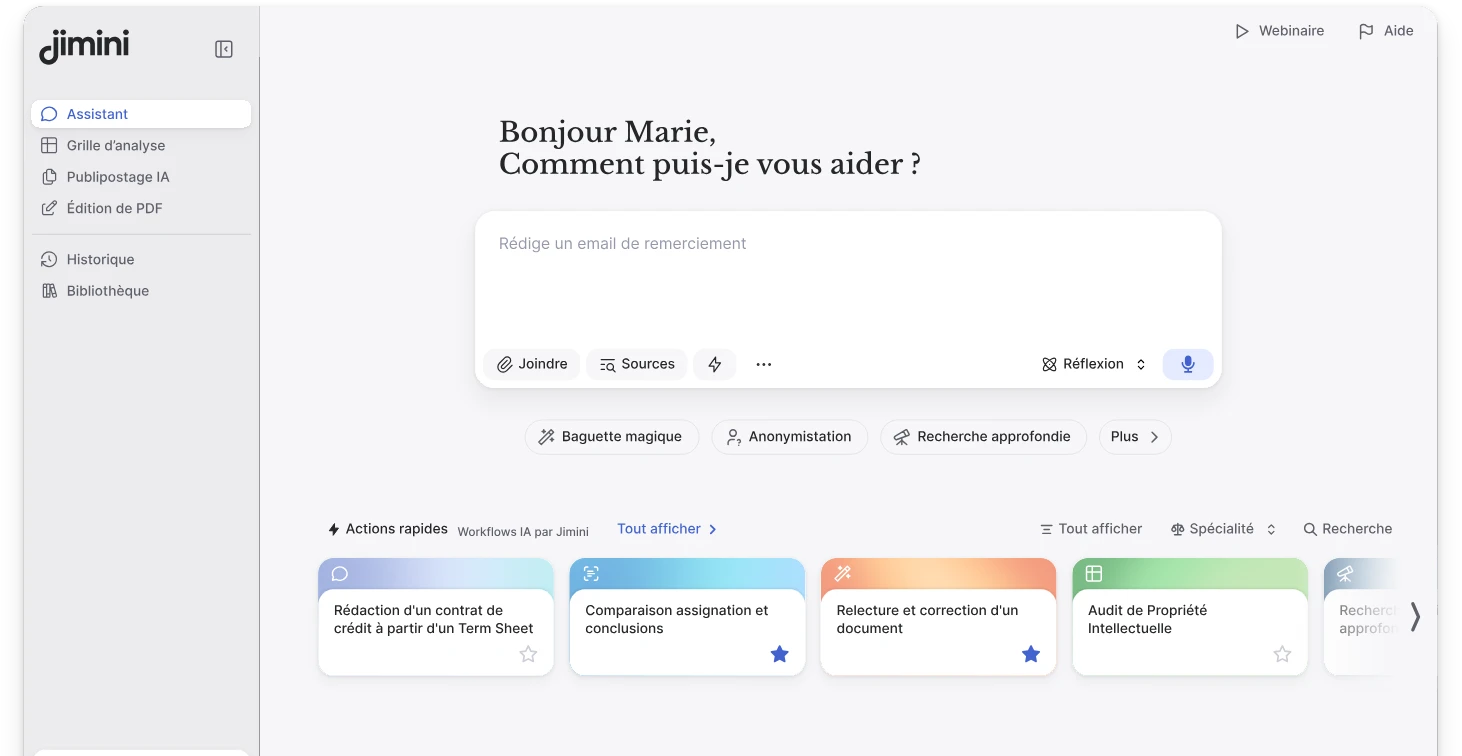
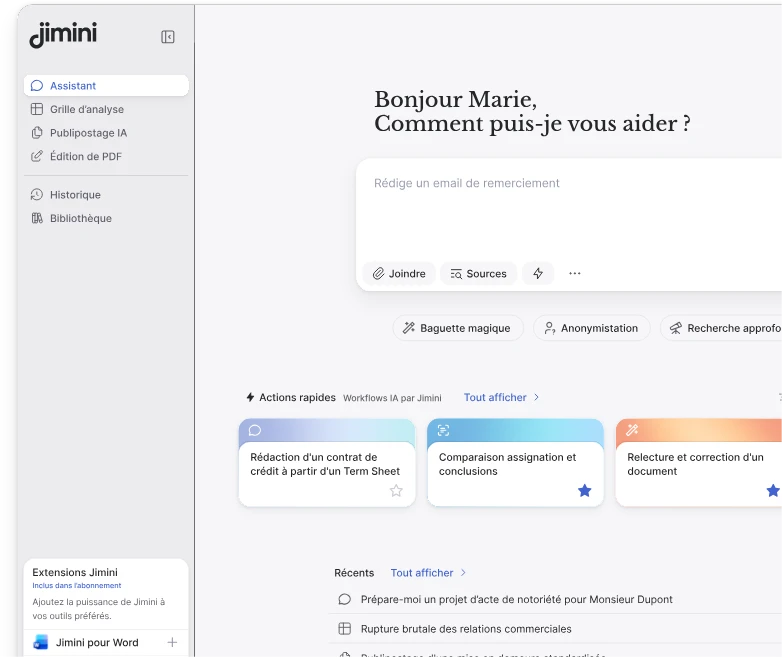
Jimini AI: a sovereign solution dedicated to contract analysis and review
Jimini AI is a legal artificial intelligence solution specifically designed for reviewing, analysing and securing contracts, co-built with lawyers and legal departments.
Unlike general-purpose tools or CLMs, Jimini is designed as a true legal copilot, working directly at the heart of the document.
Advanced legal analysis, directly in Word
With its Word plug-in, Jimini lets you:
-
analyse contracts in natural language;
-
compare versions and identify sensitive changes;
-
detect contractual inconsistencies, omissions or risks;
-
improve wording without altering the legal reasoning;
-
check the consistency of definitions, cross-references and schedules;
Tools dedicated to contract review
Jimini combines several key features useful for review:
-
legal analysis and summarisation of documents;
-
automated contract proofreading and verification;
-
customizable Analysis Grids for audits or contract reviews;
-
secure anonymisation;
-
comparing and structuring clauses.
A sovereign AI compliant with ethical obligations
Jimini is built on a 100% sovereign architecture:
-
data hosted in France;
-
a private AI trained exclusively on the client’s document base,
-
no pooling of data between clients;
-
strict respect for professional secrecy and the GDPR.
A solution designed to fit into existing practices
Jimini fits naturally into the working environment of in-house counsel and business teams:
-
with no change of tools;
-
without calling existing workflows into question;
-
as a complement to the CLM and DMS tools already in place.
Jimini is aimed at organisations that want to secure their contract reviews, reduce risk and gain efficiency, while retaining control of the legal reasoning and the confidentiality of their data.
Conclusion
Contract review today is much more than a proofreading exercise: it is a central lever for controlling legal risk, for operational fluidity and for securing commitments.
Faced with growing contract volumes, increasingly complex documents and heightened traceability and compliance requirements, traditional tools are no longer enough.
Specialised contract review software now makes it possible to analyse, compare and secure contracts quickly and in a structured way, while leaving in-house counsel in control of the reasoning and the decision.
It usefully complements CLMs and document management tools, stepping in where the legal value is highest: at the review and approval stage.
Choosing a solution that is suitable, secure and designed for legal use is therefore no longer optional, but a strategic issue for any organisation seeking to reduce its risks and improve the quality of its contracting processes.
Looking for contract review software that is reliable, sovereign and suited to your legal practices?
Jimini AI lets you analyse, compare and proofread your contracts directly in Word, powered by a private legal artificial intelligence designed to respect professional secrecy and regulatory requirements.
👉 Discover Jimini and request a demo at jimini.ai