
IA juridique : Transformer la pratique du droit avec l'intelligence artificielle
L'intelligence artificielle transforme la pratique du droit. Analyse de documents, rédaction, recherche juridique : explorez nos solutions.
L’intelligence artificielle transforme en profondeur la pratique du droit. Face à la complexité croissante des dossiers, à l’augmentation des volumes documentaires et à la pression sur les délais, les professionnels du droit s’appuient désormais sur des logiciels d’IA juridique pour cabinet d’avocats afin de gagner en efficacité. Recherche, analyse et rédaction de documents peuvent aujourd’hui être assistées par des outils performants, sans remettre en cause le rôle central de l’avocat. Cet article propose un panorama des usages, des solutions existantes et des enjeux clés liés à l’adoption responsable de l’IA juridique.
Définition du logiciel d’IA juridique
Le logiciel d’IA juridique désigne l’intégration de l’innovation technologique dans la pratique du droit. Plus précisément, ce terme fait référence à la mise à disposition et à l’utilisation de l’intelligence artificielle générative par les professionnels du droit, tels que les juristes ou les avocats.
L’intelligence artificielle générative désigne une catégorie de technologies capables de produire de nouveaux contenus (textes, images, données, etc.) à partir d’informations existantes.
Elle repose sur des modèles d’apprentissage automatique qui analysent de vastes ensembles de données pour générer des résultats originaux, pertinents et adaptés au contexte. Dans le domaine juridique, l’IA générative permet notamment d’assister les professionnels du droit dans la rédaction, l’analyse et la synthèse de documents juridiques.
Contexte et enjeux pour les professionnels du droit
L’essor de l’intelligence artificielle juridique marque une évolution majeure dans la pratique du droit. Face à l’augmentation des volumes de documents, à la pression sur les délais et à l’exigence de précision, les professionnels du droit recherchent aujourd’hui des logiciels d’IA juridique capables de leur faire gagner du temps sans compromettre la qualité ni la confidentialité de leurs consultations.
En effet, les avocats sont confrontés chaque jour à une importante quantité de documents à analyser ou à rédiger. Ce temps considérable consacré au traitement de documents essentiels n’est pourtant pas toujours facturable aux clients. Or, cette activité représente une part significative de leur quotidien. Ceci entraîne une perte de temps et réduit l’investissement sur les vraies tâches à forte valeur ajoutée.
Passer des heures, voire des jours, à lire de la documentation de crédit, ou à analyser des pièces dans un contentieux en droit pénal, n’est pas l’essentiel dans un dossier. Ainsi, l’intérêt d’utiliser l’intelligence artificielle pour un avocat est de recentrer l’essentiel de son activité sur deux aspects : la relation avec son client et la réflexion sur la stratégie à mener, qu’il s’agisse d’une activité de conseil ou de contentieux.
Comment ? Les logiciels d’avocats IA permettent en effet d’automatiser de nombreuses tâches répétitives et chronophages, telles que la recherche documentaire, l’analyse de jurisprudence, de documents ou la rédaction de projets d’actes.
En déléguant ces missions à des outils performants, l’avocat peut consacrer davantage de temps à l’écoute et à la compréhension des besoins de ses clients, ce qui renforce la qualité de la relation humaine et la personnalisation de l’accompagnement.
Panorama des logiciels d’IA juridique en 2026
Les professionnels du droit ont accès à plusieurs outils sur le marché des logiciels d’intelligence artificielle juridique. Plusieurs types d’outils existent : les IA de productivité et les IA de recherche. Certains sont axés sur un besoin, d’autres combinent les deux.
Plusieurs acteurs se distinguent ainsi par leur positionnement et leurs fonctionnalités. Voici un tour d’horizon des principales IA juridiques actuellement disponibles.
LEGORA, une legaltech suédoise qui propose une plateforme collaborative d’IA dédiée aux avocats et professionnels du droit.
Elle se distingue par son automatisation intelligente des processus juridiques qui mêle révision documentaire, recherche juridique, extraction d’informations, rédaction assistée et gestion des workflows. LEGORA est particulièrement efficace pour traiter de grands volumes de documents et structurer l’analyse.
Le paysage des technologies juridiques s’est considérablement enrichi ces dernières années, porté par l’émergence de solutions d’intelligence artificielle de plus en plus performantes.
Parmi les acteurs majeurs, HARVEY s’est imposée comme une référence internationale : développée à San Francisco, cette IA générative accompagne les équipes juridiques internes et les cabinets d’avocats dans l’analyse de documents et la due diligence, tout en permettant la création de contenus personnalisés. Son adoption par de grandes structures témoigne de son efficacité, bien qu’elle requière souvent une intégration technique avancée.
En France, l’innovation est également au rendez-vous avec des solutions telles que JIMINI AI, une IA juridique lancée en 2023
Spécifiquement conçue pour les professionnels du droit, elle propose des fonctionnalités complètes d’analyse, de rédaction et de recherche juridique, avec une intégration direct dans word et une attention particulière portée à la confidentialité des données.
De son côté, DOCTRINE s’est distinguée depuis 2016 comme un agrégateur incontournable de jurisprudence et de documents légaux. Grâce à ses outils d’IA, elle offre une recherche juridique avancée et une gestion documentaire enrichie qui permet de détecter rapidement les sources pertinentes et d’enrichir les dossiers.
Enfin, GenIA-L, développée par Lefebvre Dalloz, se démarque par l’intégration d’un fonds documentaire juridique étendu et des outils de productivité, de synthèse et d’analyse de documents. Sa conformité au RGPD et l’hébergement européen des données en font une solution particulièrement adaptée aux exigences de sécurité des professionnels du droit.
Les fonctionnalités et les bénéfices pour les professionnels du droit
L’automatisation des tâches répétitives
Une IA juridique permet d’automatiser de nombreuses tâches chronophages qui occupent une part importante du temps des professionnels du droit. Elle peut :
- analyser rapidement de grands volumes de documents ;
- comparer des contrats ;
- établir des tableaux d’analyse ;
- détecter des incohérences ;
- structurer des informations issues de dossiers complexes.
Certaines solutions permettent de générer et personnaliser des actes juridiques à partir de modèles, facilitant la production en série de documents grâce au publipostage, notamment en contentieux et en M&A.
Ainsi, les bénéfices concrets d’un logiciel d’IA juridique sont pluriels :
- une réduction significative du temps consacré aux tâches répétitives ;
- une amélioration de la productivité globale du cabinet ou du service juridique ;
- un recentrage de l’avocat sur les missions à forte valeur ajoutée telles que l’analyse, la stratégie et le conseil.
- une formation et montée en compétence IA grâce à l’IA juridique elle même.
L’aide à la rédaction
L’avocature nécessite un temps certain passé à la rédaction de contrats, de mises en demeure, d’assignations, de conclusions. Des documents qui doivent être juridiquement exacts, cohérents et correctement écrits.
Des heures passées devant un contrat ou un projet de conclusion peuvent amener son auteur à oublier certaines règles de forme ou à faire des fautes de français. Dans ce contexte, les outils d’aide à la rédaction deviennent essentiels, la moindre faute ou incohérence pouvant engager la responsabilité d’un avocat ou d’un juriste tenu à une exigence d’irréprochabilité rédactionnelle.
Les IA juridiques offrent donc une assistance avancée à la rédaction de documents juridiques, souvent directement intégrée aux outils de travail existants (comme les logiciels de traitement de texte tels que Microsoft Word). Elles permettent de rédiger, reformuler, corriger, synthétiser ou traduire des contenus juridiques à partir d’instructions en langage naturel : les fameux « prompts ».
Ces outils peuvent également :
- harmoniser le style d’un document ;
- améliorer sa clarté ;
- proposer des formulations plus précises juridiquement ;
- analyser un risque juridique tout en laissant la main à l’utilisateur pour valider chaque modification.
La production textuelle s’en trouve considérablement améliorée, et le juriste ou l’avocat passe moins de temps sur leur livrable. Une nouvelle fois, ces logiciels d’IA juridique permettent un gain de temps indispensable par une réduction du temps de révision pour es avocats et juristes toujours plus sollicités.
L’aide à la recherche juridique
Certains logiciels d’IA juridique de productivité intègrent également une fonctionnalité de recherche, et même, pour certaines d’entre elles, une recherche approfondie Deepresearch
Les IA juridiques permettent de centraliser et d’exploiter de nombreuses sources juridiques, telles que les textes, la jurisprudence, la doctrine ou encore les documents internes, au sein d’une interface unique.
Elles offrent la possibilité d’effectuer des recherches juridiques de façon plus rapide et plus ciblée, en fournissant des réponses contextualisées, structurées et accompagnées de références précises.
Les résultats obtenus peuvent être automatiquement synthétisés, ce qui facilite la compréhension de sujets complexes ainsi que la préparation d’un raisonnement juridique. Cette technologie présente des bénéfices concrets, notamment un gain de temps considérable dans la recherche juridique, une meilleure exploitation de l’information disponible et un accès plus rapide à des réponses pertinentes et structurées.
En somme, l’avocat ou le juriste détenteur d’un logiciel d’IA juridique s’octroie un véritbale outil d’optimisation de son flux de travail.
La sécurité et la conformité
L’IA juridique et le secret professionnel sont intimement corrélés. En effet, l’utilisation d’une IA juridique repose sur des exigences élevées en matière de confidentialité, de sécurité et de conformité réglementaire. Les outils d’IA juridique mettent en œuvre des mécanismes de chiffrement des données, une gestion stricte des accès et des politiques qui garantissent que les données traitées ne sont ni réutilisées ni partagées à des fins externes.
L’hébergement souverain, le respect du RGPD et l’alignement avec les obligations déontologiques des professions juridiques sont d’ailleurs des critères essentiels dans le choix d’une IA juridique.
1. La conformité au Cloud Act
L’utilisation d’une IA juridique soulève des enjeux importants en matière de souveraineté des données, notamment au regard du Cloud Act américain.
Ce texte permet aux autorités des États-Unis d’accéder à certaines données hébergées par des entreprises américaines, y compris lorsque les serveurs sont situés hors du territoire américain.
Dans un contexte juridique, où les documents traités sont hautement sensibles (jugements, assignations ou convention d’honoraires) il est essentiel de privilégier des solutions d’IA juridique dont l’hébergement et les infrastructures sont juridiquement protégés de toute extraterritorialité.
Le choix d’une plateforme conforme aux exigences européennes permet ainsi de limiter les risques d’accès non autorisé aux données juridiques et de garantir un niveau de confidentialité compatible avec les attentes des professionnels du droit.
2. Le respect du RGPD
Toute IA juridique doit être conçue dans le respect strict du Règlement (UE) 2016/679 du Parlement européen et du Conseil du 27 avril 2016, relatif à la protection des personnes physiques à l’égard du traitement des données à caractère personnel (RGPD). Cela implique notamment une gestion rigoureuse des données personnelles, une limitation des finalités de traitement et une transparence totale sur leur utilisation.
Dans le cadre d’un logiciel d’IA juridique, les documents analysés peuvent contenir des données sensibles concernant des clients, des salariés ou des tiers.
Il est donc indispensable que ces données ne soient ni réutilisées à des fins d’entraînement non maîtrisées, ni partagées avec des acteurs externes, et qu’elles fassent l’objet de mesures de sécurité adaptées, telles que le chiffrement et le contrôle des accès.
3. La compatibilité avec les règles déontologiques des avocats
L’adoption d’un logiciel juridique IA doit également être compatible avec les principes déontologiques de la profession d’avocat, notamment le secret professionnel, l’indépendance et la loyauté envers le client. Le règlement intérieur national (RIN) insiste particulièrement sur ces obligations déontologiques auxquelles les avocats sont soumis en France.
Une IA juridique ne peut en aucun cas se substituer au raisonnement juridique de l’avocat ni prendre de décisions à sa place. Elle doit être conçue comme un outil d’assistance, permettant d’augmenter les capacités de l’avocat sans remettre en cause sa responsabilité professionnelle.
Le contrôle humain demeure central : l’avocat conserve la maîtrise des analyses produites, des documents générés et des conseils délivrés au client. Le logiciel d’IA juridique demeure ainsi qu’un copilote.
Les cas d’usage de l’IA dans le secteur juridique
La rédaction d’actes et de contrats
Les logiciels d’IA juridique jouent aujourd’hui un rôle clé dans la rédaction d’actes et de contrats en apportant une assistance intelligente aux avocats et aux professionnels du droit. Grâce aux technologies de traitement du langage naturel, ces outils permettent d’accélérer la production de documents juridiques tout en améliorant leur clarté.
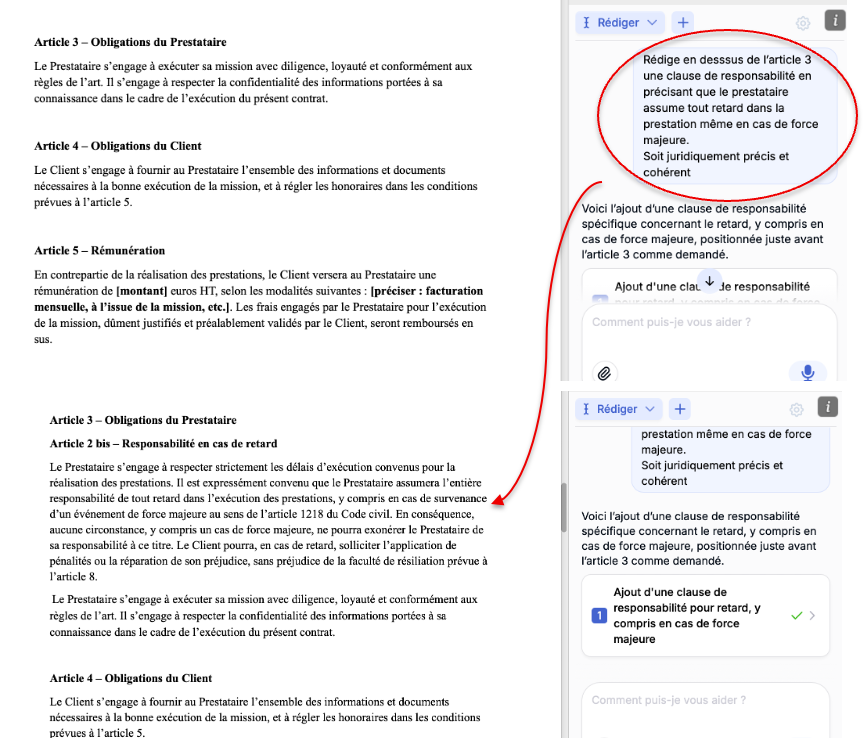
Concrètement, un avocat peut utiliser une IA juridique pour structurer un contrat de prestation de services, reformuler une clause de responsabilité, vérifier la cohérence des définitions ou harmoniser l’ensemble d’un document.
Lors de la rédaction de conclusions, l’IA peut clarifier le raisonnement juridique, synthétiser un moyen ou affiner la rédaction d’une clause, réduisant le temps de révision et les erreurs formelles, sans se substituer à l’analyse humaine.
La recherche juridique sourcée
Les outils d’IA juridique transforment également la recherche juridique et la veille jurisprudentielle en permettant d’analyser rapidement de grandes quantités de textes législatifs, de décisions de justice et de commentaires doctrinaux. Cette recherche juridique augmentée facilite l’identification des évolutions du droit, des tendances jurisprudentielles et des zones d’incertitude.
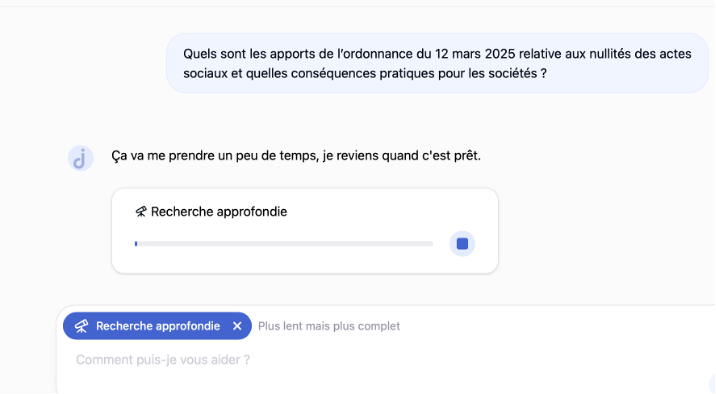
Par exemple, un avocat peut interroger un logiciel d’IA juridique avec une question approfondie telle que : « Quels sont les apports de l’ordonnance du 12 mars 2025 relative aux nullités des actes sociaux et quelles conséquences pratiques pour les sociétés ? ».L’IA est alors en mesure de fournir une synthèse juridique structurée avec un degré de précision des réponses juridiques élevé. Ce type d’usage améliore significativement l’efficacité juridique, tout en laissant à l’avocat la vérification des sources et l’appréciation finale du raisonnement.
Les critères pour choisir un logiciel d’IA juridique
Le choix d’un logiciel d’IA juridique constitue une décision stratégique pour un cabinet d’avocats ou un service juridique. Tous les outils ne se valent pas et il est essentiel d’évaluer plusieurs critères afin de sélectionner une solution réellement adaptée aux besoins professionnels et aux contraintes opérationnelles.
Les fonctionnalités clés à comparer
Le premier critère de sélection d’un logiciel d’IA juridique repose sur l’étendue et la pertinence de ses fonctionnalités. Certains outils sont orientés principalement vers la recherche juridique (comme GenIA-L de Dalloz) tandis que d’autres mettent l’accent sur la rédaction de contrats (comme Jimini AI), l’analyse de risques juridiques ou l’automatisation des tâches répétitives. Il est essentiel de vérifier si le logiciel permet seulement la recherche juridique sourcée ou la synthèse de documents juridiques, l’identification des clauses sensibles, l’analyse comparative de contrats ou encore la génération assistée d’actes. Une solution efficace doit apporter un véritable gain de productivité à condition d’être correctement utilisée et comprise par le juriste ou l’avocat.
Critère/Fonctionnalité
Description
Exemples d’outils
Recherche juridique
Accès rapide à des sources juridiques fiables et pertinentes
GenIA-L (Dalloz)
Automatisation des tâches répétitives
Automatisation de tâches telles que la génération d’actes ou la gestion documentaire
Jimini AI
Doctrine
HARVEY
Identification des clauses sensibles
Détection des clauses à risque ou nécessitant une attention particulière
Doctrine
Analyse comparative de contrats
Comparaison de plusieurs contrats pour identifier les différences et points sensibles
JIMINI
LEGORA
Le coût et le modèle économique
Le coût constitue un critère important dans l’évaluation des logiciels d’IA juridique. Les modèles économiques peuvent varier : abonnement mensuel ou annuel, facturation par utilisateur, par volume de documents ou de requête. Il est essentiel d’analyser le rapport entre le prix proposé et les gains réels en termes de réduction du temps de révision, d’automatisation des tâches et d’amélioration de l’efficacité juridique. Une solution pertinente doit générer un retour sur investissement clair, sans complexifier la gestion financière du cabinet.
La sécurité des données et conformité RGPD
Un cadre indispensable pour une adoption responsable de l’IA juridique. La prise en compte de l’AI Act, du Cloud Act, du RGPD et des règles déontologiques constitue un prérequis fondamental pour l’adoption sereine de l’IA dans le secteur juridique.
Une IA juridique fiable est avant tout une solution qui conjugue souveraineté des données, performance technologique et respect des valeurs fondamentales de la profession. En fonction du logiciel d’IA juridique utilisé, le traitement des données ne sera pas le même.
Certains vont faire appel à des serveurs locaux, d’autres à l’étranger où les données peuvent être stockées, utilisées et faire l’objet d’utilisation à des fins d’entraînement du modèle d’IA. Ainsi, le choix du logiciel d’IA juridique se fait aussi à l’aune de la politique de protection et de confidentialité des données à laquelle est soumis l’intelligence artificielle juridique.
Le support et l’accompagnement
Enfin, le niveau de support et d’accompagnement proposé par l’éditeur constitue un facteur clé de succès dans l’adoption d’un logiciel d’IA juridique. Un outil performant mais mal accompagné risque de ne pas être pleinement exploité par les équipes.
La disponibilité d’une assistance technique, de ressources pédagogiques, de formations ou de guides d’utilisation facilite l’appropriation de l’outil et favorise une montée en compétence progressive des utilisateurs. Un bon logiciel d’IA juridique est également celui qui accompagne les professionnels du droit dans la transformation de leurs pratiques, sans rupture brutale ni complexité excessive.
L’IA juridique s’impose progressivement comme un outil du quotidien pour les professionnels du droit, grâce à des analyses plus précises et une intégration renforcée dans les outils métiers.
Elle facilite la veille, l’analyse des risques, la rédaction et la synthèse de documents, sans jamais se substituer au raisonnement de l’avocat. Son adoption doit être progressive, guidée par les besoins prioritaires du cabinet ou du service juridique. Le choix d’une solution suppose une attention particulière à la confidentialité des données, au respect du RGPD, de l’AI Act du Cloud Act et des règles déontologiques.
Utilisée avec discernement et accompagnée d’une formation adaptée, l’IA juridique devient un véritable levier de performance et de qualité du conseil. Pour que l’adoption soit réussie, il faut aussi accompagner les équipes, les former aux bons usages et garder un contrôle humain sur les analyses réalisées. Utilisée avec discernement, l’IA juridique devient un véritable allié pour améliorer la qualité du conseil et renforcer la performance juridique.
Join the legal professionals of tomorrow.


I want to integrate AI into my organization