'%3e%3crect%20width='52'%20height='40'%20rx='10'%20fill='%23FFEA96'/%3e%3cg%20clip-path='url(%23clip1_2569_1375)'%3e%3crect%20width='59.0741'%20height='44'%20transform='translate(-3%20-4)'%20fill='%23A4ECF6'/%3e%3cg%20filter='url(%23filter0_f_2569_1375)'%3e%3cellipse%20cx='-10.3274'%20cy='7.80296'%20rx='36.4924'%20ry='39.2338'%20transform='rotate(11.6674%20-10.3274%207.80296)'%20fill='%23DDE2FF'/%3e%3cellipse%20cx='-10.3274'%20cy='7.80296'%20rx='36.4924'%20ry='39.2338'%20transform='rotate(11.6674%20-10.3274%207.80296)'%20stroke='%238FA6EB'%20stroke-width='21.4144'/%3e%3c/g%3e%3c/g%3e%3cpath%20d='M15.5%2029.3333L17.0167%2024.7833C14.3053%2020.7735%2015.353%2015.5993%2019.4667%2012.6803C23.5803%209.7625%2029.4883%2010.0017%2033.2858%2013.2403C37.0833%2016.4802%2037.5967%2021.7173%2034.4863%2025.4915C31.376%2029.2657%2025.6022%2030.409%2020.9833%2028.1667L15.5%2029.3333Z'%20stroke='white'%20stroke-width='1.5'%20stroke-linecap='round'%20stroke-linejoin='round'/%3e%3c/g%3e%3cdefs%3e%3cfilter%20id='filter0_f_2569_1375'%20x='-78.1925'%20y='-62.604'%20width='135.73'%20height='140.814'%20filterUnits='userSpaceOnUse'%20color-interpolation-filters='sRGB'%3e%3cfeFlood%20flood-opacity='0'%20result='BackgroundImageFix'/%3e%3cfeBlend%20mode='normal'%20in='SourceGraphic'%20in2='BackgroundImageFix'%20result='shape'/%3e%3cfeGaussianBlur%20stdDeviation='10.2764'%20result='effect1_foregroundBlur_2569_1375'/%3e%3c/filter%3e%3cclipPath%20id='clip0_2569_1375'%3e%3crect%20width='52'%20height='40'%20rx='10'%20fill='white'/%3e%3c/clipPath%3e%3cclipPath%20id='clip1_2569_1375'%3e%3crect%20width='59.0741'%20height='44'%20fill='white'%20transform='translate(-3%20-4)'/%3e%3c/clipPath%3e%3c/defs%3e%3c/svg%3e)
'%3e%3crect%20width='52'%20height='40'%20rx='10'%20fill='%23FFEA96'/%3e%3cg%20clip-path='url(%23clip1_2569_15019)'%3e%3crect%20width='84'%20height='42'%20transform='translate(-2%20-1)'%20fill='%2379BB84'/%3e%3cg%20filter='url(%23filter0_f_2569_15019)'%3e%3cellipse%20cx='51.2293'%20cy='24.9396'%20rx='37.103'%20ry='27.6663'%20transform='rotate(140.546%2051.2293%2024.9396)'%20fill='%2375D0AA'/%3e%3cellipse%20cx='51.2293'%20cy='24.9396'%20rx='37.103'%20ry='27.6663'%20transform='rotate(140.546%2051.2293%2024.9396)'%20stroke='%23A5E5AB'%20stroke-width='26'/%3e%3c/g%3e%3c/g%3e%3cpath%20d='M15.5%2017.6667H36.5M23.6667%209.5V30.5M15.5%2011.8333C15.5%2011.2145%2015.7458%2010.621%2016.1834%2010.1834C16.621%209.74583%2017.2145%209.5%2017.8333%209.5H34.1667C34.7855%209.5%2035.379%209.74583%2035.8166%2010.1834C36.2542%2010.621%2036.5%2011.2145%2036.5%2011.8333V28.1667C36.5%2028.7855%2036.2542%2029.379%2035.8166%2029.8166C35.379%2030.2542%2034.7855%2030.5%2034.1667%2030.5H17.8333C17.2145%2030.5%2016.621%2030.2542%2016.1834%2029.8166C15.7458%2029.379%2015.5%2028.7855%2015.5%2028.1667V11.8333Z'%20stroke='white'%20stroke-width='1.5'%20stroke-linecap='round'%20stroke-linejoin='round'/%3e%3c/g%3e%3cdefs%3e%3cfilter%20id='filter0_f_2569_15019'%20x='-8.68196'%20y='-33.1753'%20width='119.823'%20height='116.23'%20filterUnits='userSpaceOnUse'%20color-interpolation-filters='sRGB'%3e%3cfeFlood%20flood-opacity='0'%20result='BackgroundImageFix'/%3e%3cfeBlend%20mode='normal'%20in='SourceGraphic'%20in2='BackgroundImageFix'%20result='shape'/%3e%3cfeGaussianBlur%20stdDeviation='6.65'%20result='effect1_foregroundBlur_2569_15019'/%3e%3c/filter%3e%3cclipPath%20id='clip0_2569_15019'%3e%3crect%20width='52'%20height='40'%20rx='10'%20fill='white'/%3e%3c/clipPath%3e%3cclipPath%20id='clip1_2569_15019'%3e%3crect%20width='84'%20height='42'%20fill='white'%20transform='translate(-2%20-1)'/%3e%3c/clipPath%3e%3c/defs%3e%3c/svg%3e)
'%3e%3crect%20width='52'%20height='40'%20rx='10'%20fill='%23FFEA96'/%3e%3cg%20clip-path='url(%23clip1_2569_362)'%3e%3crect%20width='80'%20height='40'%20fill='%23D79BA2'/%3e%3cg%20filter='url(%23filter0_f_2569_362)'%3e%3cellipse%20cx='88.9522'%20cy='26.2192'%20rx='52.3951'%20ry='72.8474'%20transform='rotate(36.0726%2088.9522%2026.2192)'%20fill='%23B6CDEA'/%3e%3cellipse%20cx='88.9522'%20cy='26.2192'%20rx='52.3951'%20ry='72.8474'%20transform='rotate(36.0726%2088.9522%2026.2192)'%20stroke='%23829BB8'%20stroke-width='27'/%3e%3c/g%3e%3c/g%3e%3cpath%20d='M29.5%209.5V14.1667C29.5%2014.4761%2029.6229%2014.7728%2029.8417%2014.9916C30.0605%2015.2104%2030.3572%2015.3333%2030.6666%2015.3333H35.3333M35.3333%2015.3333L29.5%209.5H24.8333C24.2145%209.5%2023.621%209.74583%2023.1834%2010.1834C22.7458%2010.621%2022.5%2011.2145%2022.5%2011.8333V23.5C22.5%2024.1188%2022.7458%2024.7123%2023.1834%2025.1499C23.621%2025.5875%2024.2145%2025.8333%2024.8333%2025.8333H33C33.6188%2025.8333%2034.2123%2025.5875%2034.6499%2025.1499C35.0875%2024.7123%2035.3333%2024.1188%2035.3333%2023.5V15.3333ZM30.6666%2025.8333V28.1667C30.6666%2028.7855%2030.4208%2029.379%2029.9832%2029.8166C29.5456%2030.2542%2028.9522%2030.5%2028.3333%2030.5H20.1666C19.5478%2030.5%2018.9543%2030.2542%2018.5167%2029.8166C18.0791%2029.379%2017.8333%2028.7855%2017.8333%2028.1667V16.5C17.8333%2015.8812%2018.0791%2015.2877%2018.5167%2014.8501C18.9543%2014.4125%2019.5478%2014.1667%2020.1666%2014.1667H22.5'%20stroke='white'%20stroke-width='1.5'%20stroke-linecap='round'%20stroke-linejoin='round'/%3e%3c/g%3e%3cdefs%3e%3cfilter%20id='filter0_f_2569_362'%20x='-15.6247'%20y='-84.562'%20width='209.154'%20height='221.562'%20filterUnits='userSpaceOnUse'%20color-interpolation-filters='sRGB'%3e%3cfeFlood%20flood-opacity='0'%20result='BackgroundImageFix'/%3e%3cfeBlend%20mode='normal'%20in='SourceGraphic'%20in2='BackgroundImageFix'%20result='shape'/%3e%3cfeGaussianBlur%20stdDeviation='15.4'%20result='effect1_foregroundBlur_2569_362'/%3e%3c/filter%3e%3cclipPath%20id='clip0_2569_362'%3e%3crect%20width='52'%20height='40'%20rx='10'%20fill='white'/%3e%3c/clipPath%3e%3cclipPath%20id='clip1_2569_362'%3e%3crect%20width='80'%20height='40'%20fill='white'/%3e%3c/clipPath%3e%3c/defs%3e%3c/svg%3e)
'%3e%3crect%20width='52'%20height='40'%20rx='10'%20fill='%23FFEA96'/%3e%3cg%20clip-path='url(%23clip1_2569_6710)'%3e%3crect%20width='80'%20height='40'%20transform='translate(-15)'%20fill='%233D8E9C'/%3e%3cg%20filter='url(%23filter0_f_2569_6710)'%3e%3cellipse%20cx='32.2505'%20cy='16.4558'%20rx='51.5307'%20ry='23.1466'%20transform='rotate(50.2591%2032.2505%2016.4558)'%20fill='%2364E7DE'/%3e%3cpath%20d='M44.5377%206.2394C53.1416%2016.5878%2058.8151%2027.267%2061.2268%2035.9325C63.8373%2045.3129%2062.0035%2049.4129%2060.6132%2050.5689C59.2229%2051.7249%2054.8566%2052.7803%2046.11%2048.501C38.0303%2044.548%2028.5662%2037.0204%2019.9623%2026.672C11.3585%2016.3236%205.68548%205.64501%203.27384%20-3.02044C0.663075%20-12.4014%202.49786%20-16.5016%203.88815%20-17.6575C5.27854%20-18.8134%209.64428%20-19.868%2018.3906%20-15.5889C26.4702%20-11.6359%2035.9338%20-4.10886%2044.5377%206.2394Z'%20stroke='%234ECDC4'%20stroke-width='14.3333'/%3e%3c/g%3e%3c/g%3e%3cpath%20d='M20.1667%2029.3333H31.8333M19%2013L26%2011.8333L33%2013M19%2013L22.5%2020C22.5%2020.9283%2022.1313%2021.8185%2021.4749%2022.4749C20.8185%2023.1313%2019.9283%2023.5%2019%2023.5C18.0717%2023.5%2017.1815%2023.1313%2016.5251%2022.4749C15.8687%2021.8185%2015.5%2020.9283%2015.5%2020L19%2013ZM33%2013L36.5%2020C36.5%2020.9283%2036.1313%2021.8185%2035.4749%2022.4749C34.8185%2023.1313%2033.9283%2023.5%2033%2023.5C32.0717%2023.5%2031.1815%2023.1313%2030.5251%2022.4749C29.8687%2021.8185%2029.5%2020.9283%2029.5%2020L33%2013ZM26%209.5V29.3333'%20stroke='white'%20stroke-width='1.5'%20stroke-linecap='round'%20stroke-linejoin='round'/%3e%3c/g%3e%3cdefs%3e%3cfilter%20id='filter0_f_2569_6710'%20x='-18.2683'%20y='-38.9196'%20width='101.038'%20height='110.751'%20filterUnits='userSpaceOnUse'%20color-interpolation-filters='sRGB'%3e%3cfeFlood%20flood-opacity='0'%20result='BackgroundImageFix'/%3e%3cfeBlend%20mode='normal'%20in='SourceGraphic'%20in2='BackgroundImageFix'%20result='shape'/%3e%3cfeGaussianBlur%20stdDeviation='6.53333'%20result='effect1_foregroundBlur_2569_6710'/%3e%3c/filter%3e%3cclipPath%20id='clip0_2569_6710'%3e%3crect%20width='52'%20height='40'%20rx='10'%20fill='white'/%3e%3c/clipPath%3e%3cclipPath%20id='clip1_2569_6710'%3e%3crect%20width='80'%20height='40'%20fill='white'%20transform='translate(-15)'/%3e%3c/clipPath%3e%3c/defs%3e%3c/svg%3e)
'%3e%3crect%20width='52'%20height='40'%20rx='10'%20fill='%23FFEA96'/%3e%3cg%20clip-path='url(%23clip1_2569_4656)'%3e%3crect%20width='100'%20height='50'%20transform='translate(-24%20-4)'%20fill='%238D8DCF'/%3e%3cg%20filter='url(%23filter0_f_2569_4656)'%3e%3cellipse%20cx='16.4735'%20cy='40.123'%20rx='70.3864'%20ry='33.942'%20transform='rotate(-179.853%2016.4735%2040.123)'%20fill='%23D6C6FF'/%3e%3cpath%20d='M16.4056%2066.4097C-2.13768%2066.3619%20-18.5399%2062.679%20-30.016%2057.1085C-42.0318%2051.276%20-46.2693%2044.7259%20-46.2571%2039.9612C-46.2446%2035.1965%20-41.9732%2028.6691%20-29.9279%2022.8987C-18.4234%2017.3873%20-2.00237%2013.7889%2016.5409%2013.8366C35.084%2013.8843%2051.4863%2017.5673%2062.9624%2023.1377C74.978%2028.9701%2079.2165%2035.5194%2079.2045%2040.2841C79.1922%2045.0488%2074.9201%2051.577%2062.8743%2057.3476C51.3697%2062.8588%2034.9487%2066.4574%2016.4056%2066.4097Z'%20stroke='%239B89EE'%20stroke-width='15.311'/%3e%3c/g%3e%3c/g%3e%3cpath%20d='M28.3333%209.5V14.1667C28.3333%2014.4761%2028.4563%2014.7728%2028.6751%2014.9916C28.8938%2015.2104%2029.1906%2015.3333%2029.5%2015.3333H34.1667M34.1667%2020V15.3333L28.3333%209.5H20.1667C19.5478%209.5%2018.9543%209.74583%2018.5168%2010.1834C18.0792%2010.621%2017.8333%2011.2145%2017.8333%2011.8333V20M17.8333%2027H19.5833C20.0475%2027%2020.4926%2026.8156%2020.8208%2026.4874C21.149%2026.1592%2021.3333%2025.7141%2021.3333%2025.25C21.3333%2024.7859%2021.149%2024.3408%2020.8208%2024.0126C20.4926%2023.6844%2020.0475%2023.5%2019.5833%2023.5H17.8333V30.5M31.8333%2027H34.1667M35.3333%2023.5H31.8333V30.5M24.8333%2023.5V30.5H26C26.6188%2030.5%2027.2123%2030.2542%2027.6499%2029.8166C28.0875%2029.379%2028.3333%2028.7855%2028.3333%2028.1667V25.8333C28.3333%2025.2145%2028.0875%2024.621%2027.6499%2024.1834C27.2123%2023.7458%2026.6188%2023.5%2026%2023.5H24.8333Z'%20stroke='white'%20stroke-width='1.5'%20stroke-linecap='round'%20stroke-linejoin='round'/%3e%3c/g%3e%3cdefs%3e%3cfilter%20id='filter0_f_2569_4656'%20x='-70.246'%20y='-10.1527'%20width='173.439'%20height='100.551'%20filterUnits='userSpaceOnUse'%20color-interpolation-filters='sRGB'%3e%3cfeFlood%20flood-opacity='0'%20result='BackgroundImageFix'/%3e%3cfeBlend%20mode='normal'%20in='SourceGraphic'%20in2='BackgroundImageFix'%20result='shape'/%3e%3cfeGaussianBlur%20stdDeviation='8.16667'%20result='effect1_foregroundBlur_2569_4656'/%3e%3c/filter%3e%3cclipPath%20id='clip0_2569_4656'%3e%3crect%20width='52'%20height='40'%20rx='10'%20fill='white'/%3e%3c/clipPath%3e%3cclipPath%20id='clip1_2569_4656'%3e%3crect%20width='100'%20height='50'%20fill='white'%20transform='translate(-24%20-4)'/%3e%3c/clipPath%3e%3c/defs%3e%3c/svg%3e)
'%3e%3crect%20width='52'%20height='40'%20rx='10'%20fill='%23FFEA96'/%3e%3cg%20clip-path='url(%23clip1_2569_4888)'%3e%3crect%20width='100'%20height='50'%20transform='translate(-24%20-4)'%20fill='%2386568A'/%3e%3cg%20filter='url(%23filter0_f_2569_4888)'%3e%3cellipse%20cx='22.6407'%20cy='24.5662'%20rx='70.3864'%20ry='17.9732'%20transform='rotate(-58.3133%2022.6407%2024.5662)'%20fill='%23F3B3F5'/%3e%3cellipse%20cx='22.6407'%20cy='24.5662'%20rx='70.3864'%20ry='17.9732'%20transform='rotate(-58.3133%2022.6407%2024.5662)'%20stroke='%23B97ACE'%20stroke-width='13'/%3e%3c/g%3e%3c/g%3e%3cpath%20d='M27.1667%209.5V17.6667H34.1667L24.8333%2030.5V22.3333H17.8333L27.1667%209.5Z'%20stroke='white'%20stroke-width='1.5'%20stroke-linecap='round'%20stroke-linejoin='round'/%3e%3c/g%3e%3cdefs%3e%3cfilter%20id='filter0_f_2569_4888'%20x='-38.5803'%20y='-57.283'%20width='122.442'%20height='163.698'%20filterUnits='userSpaceOnUse'%20color-interpolation-filters='sRGB'%3e%3cfeFlood%20flood-opacity='0'%20result='BackgroundImageFix'/%3e%3cfeBlend%20mode='normal'%20in='SourceGraphic'%20in2='BackgroundImageFix'%20result='shape'/%3e%3cfeGaussianBlur%20stdDeviation='7.35'%20result='effect1_foregroundBlur_2569_4888'/%3e%3c/filter%3e%3cclipPath%20id='clip0_2569_4888'%3e%3crect%20width='52'%20height='40'%20rx='10'%20fill='white'/%3e%3c/clipPath%3e%3cclipPath%20id='clip1_2569_4888'%3e%3crect%20width='100'%20height='50'%20fill='white'%20transform='translate(-24%20-4)'/%3e%3c/clipPath%3e%3c/defs%3e%3c/svg%3e)



Contract review software: comparison, features and professional solutions
While 83% of legal departments expect their workload to increase in the short and medium term (CLOC, State of the Industry Report 2025), contract review has become a critical issue for companies, firms and public organisations.
In other words: software-assisted contract review is no longer an innovation, but a **Strategic function **To limit risks, speed up negotiations and secure legal commitments.
Why is contractual revision becoming a major issue?
In addition to the increase in contractual volume, legal departments must now deal with an increased requirement for precision, justification and traceability. Every change needs to be justified, every risk identified needs to be documented, and every inconsistency needs to be detected very early, tasks that quickly become obsolete without software assistance.
In this context, choosing the right tool has become essential. Let’s start by precisely defining what contract review software is.
What is contract review software?
Contract review software is a tool designed to analyse, compare, correct and secure A contract throughout its life cycle. It is not a simple proofreader or document manager, but a specialised solution capable of:
-
compare two versions of a contract and detect sensitive changes;
-
identify risky contractual stereotypes (inconsistent definitions, missing clauses, etc.);
-
analyse compliance with internal legal policies;
-
check references, appendices, references, numbers;
-
Automate the review and produce suggestions;
-
facilitate negotiation and validation between stakeholders.
Its role: Making proofreading more reliable, reducing human errors, speeding up negotiations and strengthening legal certainty.
In practice, this software is based on artificial intelligence models trained to recognise contractual structures, dependencies between clauses and recurring risk patterns.
AI is not intended to replace the lawyer, but to assist him by prioritising points of vigilance, automating verifications and securing proofreading.
Concretely,** **A lawyer receives a new version of a service contract in order to close. In a few seconds, the software:
-
compare V2 to V1 and highlights that the liability clause has been extended;
-
notes that the definition of “Confidential Data” no longer corresponds to internal policies;
-
reports the absence of the technical annex referred to in Article 4;
-
proposed to be reformulated in accordance with the internal model;
-
Generates a risk report to be shared with the operational team.
Result: the proofreading is Swifter, More reliable, and the legal team secures the negotiation without missing a critical point.
How does contract review software differ from a CLM?
One CLM (Contract Lifecycle Management) Is a software intended for Administratively Manage the Life Cycle of Contracts : import, creation, storage, approval workflows, approval workflows, collaboration, electronic signature, deadline monitoring and archiving.
It effectively structures the contractual processes of legal, purchasing, finance, or commercial departments.
**But its ability to review is limited. **
A CLM focuses primarily on:
-
track changes;
-
version management;
-
Some standardised models.
He Does Not Detect :
-
inconsistencies in definitions;
-
legal errors;
-
omissions involving a risk;
-
the missing mandatory clauses;
-
structural inconsistencies.
It is not designed to analyse legal reasoning or to offer contextualised corrections.
Thus, a CLM is essential to organise the administrative management of contracts, but is not sufficient to carry out a reliable and secure review.
Specialised revision software provides real added value: in-depth legal analysis, detailed risk detection, accurate automatic proofreading and understanding of the contractual context.
In summary :
The CLM structure. The software review is secure.
The two are complementary but do not serve the same function.
The essential functionalities of a contract review software
To understand what we really expect from revision software, we must start from the daily lives of legal and operational professionals: read quickly, compare versions, detect risks and secure validations.
Behind this requirement, five major needs stand out.
1. Real Legal Analysis, Not Just Improved Track Changes
Professionals are not looking for a tool that reads for them, but an assistant that can:
-
identify inconsistencies that are invisible to the human eye;
-
analyse the contractual logic;
-
detecting omissions, duplicates, or contradictions;
-
report deviations from internal models;
-
identify sensitive or absent clauses.
The aim is not simply to Monitor text, but of course Making Legal Reasoning More Reliable, saving considerable time on the points of vigilance.
Concrete case: the software can, for example, detect that a definition is used without having been defined, or identify that a liability clause has disappeared during a supplier return trip, two anomalies that are frequent, but often difficult to identify quickly.
2. An intelligent comparison of versions
Comparison is at the heart of contract work, but it is time consuming and a source of human error.
Specialised software should make it possible to:
-
compare two versions line by line or clause by clause;
-
isolate sensitive changes;
-
understand the real impact of deletions or additions;
-
Generate a table of differences that can be used in negotiations.
It’s no longer a simple redline: it’s a analysis of the evolution of the contract, risk-oriented.
3. Automated detection of contractual risks
Before validating a contract, you must be sure that you have not let anything pass you by.
Good review software will report:
-
inconsistencies between definitions;
-
incorrect referrals;
-
missing mandatory clauses;
-
structural defects (numbering, appendices, versions);
-
GDPR risks, security, liability, liability, penalties, insurance.
That’s what an experienced lawyer normally does — but in a few seconds, without risk of forgetting.
4. Seamless collaboration between teams and existing tools
Contracts are never reviewed alone: legal, purchasing, commercial, financial and management are involved.
The tool must therefore allow:
-
working simultaneously on the same document;
-
coordinated feedback;
-
fine-grained monitoring of changes;
-
compatibility with Word, OneDrive, SharePoint, EDM and CLM;
-
simple and controlled workflows.
It’s not just a verification tool: it’s a collective work tool.
5. Impeccable security, without compromise
Contractual review involves sensitive information: personal data, financial commitments, technical details, negotiation strategies…
Serious revision software should guarantee:
-
European or French hosting;
-
non-shared AI;
-
no transfer to public models,
-
strict compliance with the GDPR,
-
complete traceability.
Without this, the tool becomes unusable for a legal professional.
What profiles is contract review software aimed at? These tools are mainly aimed at legal departments, lawyers, purchasing managers, CFOs and operational teams involved in contractual negotiation and validation. They are particularly useful for organisations that manage a significant volume of contracts or are exposed to high legal risks.
What are the best contract review software?
The contract review software market is now based on three main families of solutions, which should be clearly distinguished to avoid functional confusion.
1. The review modules integrated into CLMs
Some Contract Lifecycle Management tools offer version comparison or basic proofreading features.
These solutions are adapted to:
-
contract life cycle management;
-
tracking versions and approvals;
-
large volumes of standardised contracts.
On the other hand, their abilities to thorough legal review remain limited: the analysis focuses mainly on textual differences, without understanding legal reasoning or detailed risk detection.
2. Generalist AI tools for contracts
General-purpose AI solutions can be used to review or rephrase clauses. They offer good editorial support, but have several limitations for professional use:
-
lack of structured legal analysis;
-
data privacy risks;
-
results that are often generic;
-
poor integration into existing legal workflows
They are not, by themselves, a reliable contractual review tool in a sensitive or regulated context.
3. Specialised software for AI-assisted contract review
These solutions are specifically designed for analyse, compare and secure contracts. They are distinguished by:
-
an understanding of contractual reasoning,
-
automated detection of legal risks,
-
the contextual analysis of the clauses,
-
a smooth integration into the lawyer’s work tools (Word, DMS, etc.).
It is in this category that the most suitable solutions are located for legal departments, law firms and organisations subject to high compliance requirements.
How much does contract review software cost?
The prices of contract review software vary greatly depending on their level of specialisation and their functional scope.
-
Modules integrated into CLMs : often included in global licences, with costs that can range from several hundred to several thousand euros per user per year.
-
General AI tools : relatively accessible monthly subscriptions, but without sufficient guarantees of compliance, security or legal relevance.
-
Specialised contract review solutions : pricing generally between €100 and €300 per user per month, depending on the depth of the analysis, the functionalities and the level of security proposed.
The cost should be put into perspective with time savings, the reduction of contractual risk And the reduction in human errors, which often represent a quick return on investment.
How do I choose the right tool?
The choice of contractual review software must be based on specific criteria, directly linked to the daily practice of teams.
1. Depth of legal analysis
The tool should go beyond simple textual comparison and be able to:
-
detecting contractual inconsistencies;
-
analyse sensitive clauses;
-
understand the legal context of the document
2. Integration into existing tools
Good revision software fits naturally into:
-
Word; eDMS (SharePoint, OneDrive, etc.);
-
existing contractual workflows, without imposing a break in work habits.
3. Data Security and Sovereignty
This is a decisive criterion for legal professionals:
-
European or French hosting;
-
Non-shared AI;
-
lack of reuse of data;
-
strict GDPR compliance and ethical requirements.
4. Adaptability to practice
The software must work from:
-
internal models; existing contractual positions;
-
specific uses of the organisation.
5. Cost transparency and support
Clear pricing, responsive support and on-boarding support are essential for sustainable adoption.
Jimini AI: a sovereign solution dedicated to contractual analysis and review
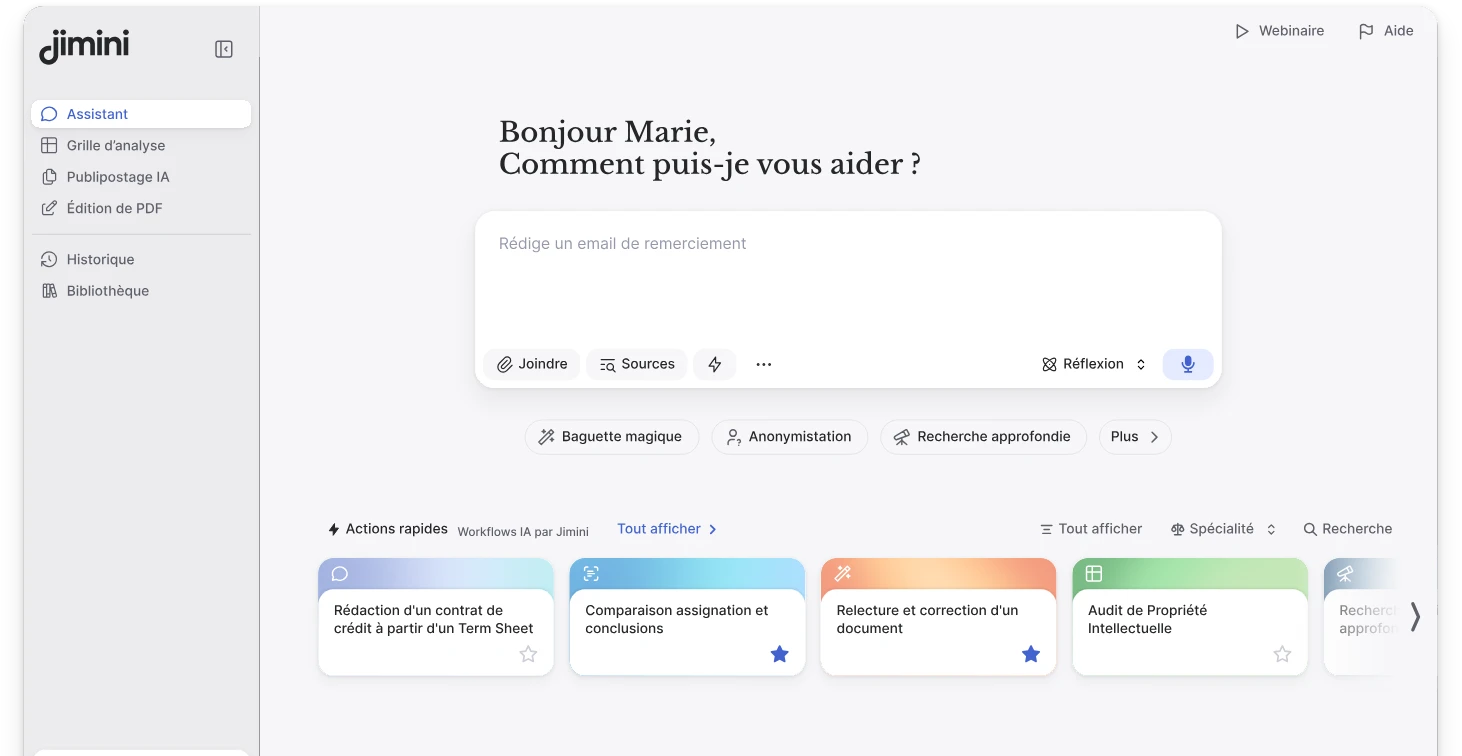
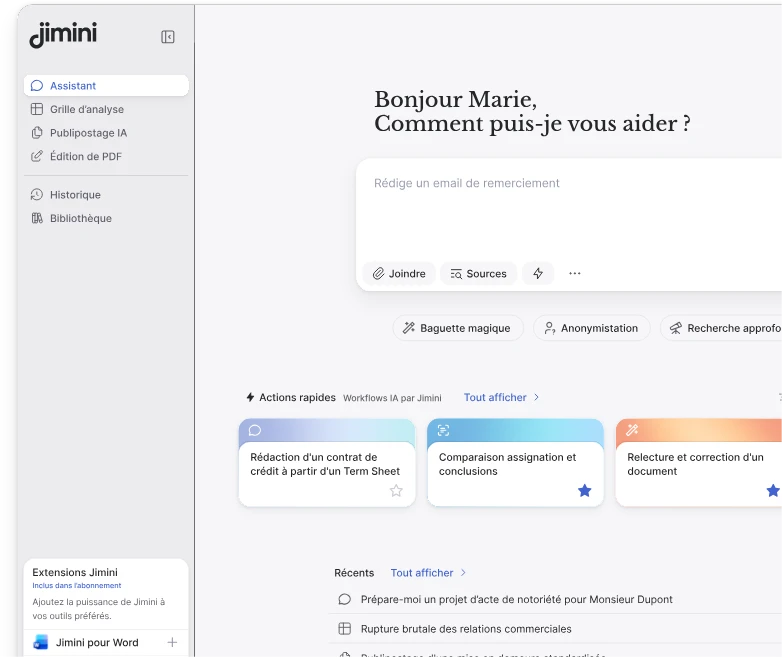
Jimini AI is a legal artificial intelligence solution Specifically designed for the review, analysis and security of contracts, co-built with lawyers and legal departments.
Unlike General Tools or CLMs, Jimini is designed as a Real Legal Co-Pilot, intervening directly at the heart of the document.
Advanced Legal Analysis, Directly in Word
Thanks to its Word plug-in, Jimini allows you to:
-
analyse contracts in natural language;
-
compare versions and identify sensitive changes;
-
detecting inconsistencies, omissions, or contractual risks;
-
improve the wording without altering legal reasoning;
-
check the consistency of definitions, references and appendices;
Tools dedicated to contractual review
Jimini combines several key features that are useful for revision:
-
legal analysis and synthesis of documents;
-
proofreading and automated contract verification;
-
customizable analysis grids for audits or contractual reviews;
-
secure anonymisation;
-
comparison and structuring of clauses.
A sovereign AI that complies with ethical requirements
Jimini is based on architecture 100% sovereign :
-
data hosted in France;
-
Private AI trained exclusively on the client’s documentary basis,
-
no inter-client sharing;
-
strict compliance with professional secrecy and the GDPR.
A solution designed to integrate with existing practices
Jimini fits naturally into the work environment of legal and operational professionals:
-
without tool changes;
-
without calling into question existing workflows;
-
In addition to the CLM and DMS already in place.
Jimini is thus aimed at organisations that want Secure Their Contractual Reviews, reduce risks and gain efficiency, while maintaining control of legal reasoning and the confidentiality of their data.
Conclusion
Contractual Review is now much more than a proofreading exercise: it is a Central Lever for Controlling Legal Risk, operational fluidity and the securing of commitments.
Faced with increasing contractual volumes, increasing document complexity, and increased traceability and compliance requirements, traditional tools are no longer enough.
Specialised contract review software now makes it possible to analyse, compare and review contracts quickly and systematically, while leaving the lawyer in control of reasoning and decisions.
They are a useful complement to CLM and document management tools, by intervening where the legal value is the strongest: At the Time of Review and Validation.
Choosing a solution that is adapted, secure and designed for legal uses is therefore no longer an option, but a Strategic Challenge for Any Organisation eager to reduce its risks and improve the quality of its contractual processes.
Are you looking for a Reliable, sovereign contract review software adapted to your legal practices ?
Jimini AI Allows you to analyse, compare and review your contracts directly in Word, thanks to a Private Legal Artificial Intelligence, designed to respect professional secrecy and regulatory requirements.
👉 Discover Jimini and request a demo on jimini.ai