'%3e%3crect%20width='52'%20height='40'%20rx='10'%20fill='%23FFEA96'/%3e%3cg%20clip-path='url(%23clip1_2569_1375)'%3e%3crect%20width='59.0741'%20height='44'%20transform='translate(-3%20-4)'%20fill='%23A4ECF6'/%3e%3cg%20filter='url(%23filter0_f_2569_1375)'%3e%3cellipse%20cx='-10.3274'%20cy='7.80296'%20rx='36.4924'%20ry='39.2338'%20transform='rotate(11.6674%20-10.3274%207.80296)'%20fill='%23DDE2FF'/%3e%3cellipse%20cx='-10.3274'%20cy='7.80296'%20rx='36.4924'%20ry='39.2338'%20transform='rotate(11.6674%20-10.3274%207.80296)'%20stroke='%238FA6EB'%20stroke-width='21.4144'/%3e%3c/g%3e%3c/g%3e%3cpath%20d='M15.5%2029.3333L17.0167%2024.7833C14.3053%2020.7735%2015.353%2015.5993%2019.4667%2012.6803C23.5803%209.7625%2029.4883%2010.0017%2033.2858%2013.2403C37.0833%2016.4802%2037.5967%2021.7173%2034.4863%2025.4915C31.376%2029.2657%2025.6022%2030.409%2020.9833%2028.1667L15.5%2029.3333Z'%20stroke='white'%20stroke-width='1.5'%20stroke-linecap='round'%20stroke-linejoin='round'/%3e%3c/g%3e%3cdefs%3e%3cfilter%20id='filter0_f_2569_1375'%20x='-78.1925'%20y='-62.604'%20width='135.73'%20height='140.814'%20filterUnits='userSpaceOnUse'%20color-interpolation-filters='sRGB'%3e%3cfeFlood%20flood-opacity='0'%20result='BackgroundImageFix'/%3e%3cfeBlend%20mode='normal'%20in='SourceGraphic'%20in2='BackgroundImageFix'%20result='shape'/%3e%3cfeGaussianBlur%20stdDeviation='10.2764'%20result='effect1_foregroundBlur_2569_1375'/%3e%3c/filter%3e%3cclipPath%20id='clip0_2569_1375'%3e%3crect%20width='52'%20height='40'%20rx='10'%20fill='white'/%3e%3c/clipPath%3e%3cclipPath%20id='clip1_2569_1375'%3e%3crect%20width='59.0741'%20height='44'%20fill='white'%20transform='translate(-3%20-4)'/%3e%3c/clipPath%3e%3c/defs%3e%3c/svg%3e)
'%3e%3crect%20width='52'%20height='40'%20rx='10'%20fill='%23FFEA96'/%3e%3cg%20clip-path='url(%23clip1_2569_15019)'%3e%3crect%20width='84'%20height='42'%20transform='translate(-2%20-1)'%20fill='%2379BB84'/%3e%3cg%20filter='url(%23filter0_f_2569_15019)'%3e%3cellipse%20cx='51.2293'%20cy='24.9396'%20rx='37.103'%20ry='27.6663'%20transform='rotate(140.546%2051.2293%2024.9396)'%20fill='%2375D0AA'/%3e%3cellipse%20cx='51.2293'%20cy='24.9396'%20rx='37.103'%20ry='27.6663'%20transform='rotate(140.546%2051.2293%2024.9396)'%20stroke='%23A5E5AB'%20stroke-width='26'/%3e%3c/g%3e%3c/g%3e%3cpath%20d='M15.5%2017.6667H36.5M23.6667%209.5V30.5M15.5%2011.8333C15.5%2011.2145%2015.7458%2010.621%2016.1834%2010.1834C16.621%209.74583%2017.2145%209.5%2017.8333%209.5H34.1667C34.7855%209.5%2035.379%209.74583%2035.8166%2010.1834C36.2542%2010.621%2036.5%2011.2145%2036.5%2011.8333V28.1667C36.5%2028.7855%2036.2542%2029.379%2035.8166%2029.8166C35.379%2030.2542%2034.7855%2030.5%2034.1667%2030.5H17.8333C17.2145%2030.5%2016.621%2030.2542%2016.1834%2029.8166C15.7458%2029.379%2015.5%2028.7855%2015.5%2028.1667V11.8333Z'%20stroke='white'%20stroke-width='1.5'%20stroke-linecap='round'%20stroke-linejoin='round'/%3e%3c/g%3e%3cdefs%3e%3cfilter%20id='filter0_f_2569_15019'%20x='-8.68196'%20y='-33.1753'%20width='119.823'%20height='116.23'%20filterUnits='userSpaceOnUse'%20color-interpolation-filters='sRGB'%3e%3cfeFlood%20flood-opacity='0'%20result='BackgroundImageFix'/%3e%3cfeBlend%20mode='normal'%20in='SourceGraphic'%20in2='BackgroundImageFix'%20result='shape'/%3e%3cfeGaussianBlur%20stdDeviation='6.65'%20result='effect1_foregroundBlur_2569_15019'/%3e%3c/filter%3e%3cclipPath%20id='clip0_2569_15019'%3e%3crect%20width='52'%20height='40'%20rx='10'%20fill='white'/%3e%3c/clipPath%3e%3cclipPath%20id='clip1_2569_15019'%3e%3crect%20width='84'%20height='42'%20fill='white'%20transform='translate(-2%20-1)'/%3e%3c/clipPath%3e%3c/defs%3e%3c/svg%3e)
'%3e%3crect%20width='52'%20height='40'%20rx='10'%20fill='%23FFEA96'/%3e%3cg%20clip-path='url(%23clip1_2569_362)'%3e%3crect%20width='80'%20height='40'%20fill='%23D79BA2'/%3e%3cg%20filter='url(%23filter0_f_2569_362)'%3e%3cellipse%20cx='88.9522'%20cy='26.2192'%20rx='52.3951'%20ry='72.8474'%20transform='rotate(36.0726%2088.9522%2026.2192)'%20fill='%23B6CDEA'/%3e%3cellipse%20cx='88.9522'%20cy='26.2192'%20rx='52.3951'%20ry='72.8474'%20transform='rotate(36.0726%2088.9522%2026.2192)'%20stroke='%23829BB8'%20stroke-width='27'/%3e%3c/g%3e%3c/g%3e%3cpath%20d='M29.5%209.5V14.1667C29.5%2014.4761%2029.6229%2014.7728%2029.8417%2014.9916C30.0605%2015.2104%2030.3572%2015.3333%2030.6666%2015.3333H35.3333M35.3333%2015.3333L29.5%209.5H24.8333C24.2145%209.5%2023.621%209.74583%2023.1834%2010.1834C22.7458%2010.621%2022.5%2011.2145%2022.5%2011.8333V23.5C22.5%2024.1188%2022.7458%2024.7123%2023.1834%2025.1499C23.621%2025.5875%2024.2145%2025.8333%2024.8333%2025.8333H33C33.6188%2025.8333%2034.2123%2025.5875%2034.6499%2025.1499C35.0875%2024.7123%2035.3333%2024.1188%2035.3333%2023.5V15.3333ZM30.6666%2025.8333V28.1667C30.6666%2028.7855%2030.4208%2029.379%2029.9832%2029.8166C29.5456%2030.2542%2028.9522%2030.5%2028.3333%2030.5H20.1666C19.5478%2030.5%2018.9543%2030.2542%2018.5167%2029.8166C18.0791%2029.379%2017.8333%2028.7855%2017.8333%2028.1667V16.5C17.8333%2015.8812%2018.0791%2015.2877%2018.5167%2014.8501C18.9543%2014.4125%2019.5478%2014.1667%2020.1666%2014.1667H22.5'%20stroke='white'%20stroke-width='1.5'%20stroke-linecap='round'%20stroke-linejoin='round'/%3e%3c/g%3e%3cdefs%3e%3cfilter%20id='filter0_f_2569_362'%20x='-15.6247'%20y='-84.562'%20width='209.154'%20height='221.562'%20filterUnits='userSpaceOnUse'%20color-interpolation-filters='sRGB'%3e%3cfeFlood%20flood-opacity='0'%20result='BackgroundImageFix'/%3e%3cfeBlend%20mode='normal'%20in='SourceGraphic'%20in2='BackgroundImageFix'%20result='shape'/%3e%3cfeGaussianBlur%20stdDeviation='15.4'%20result='effect1_foregroundBlur_2569_362'/%3e%3c/filter%3e%3cclipPath%20id='clip0_2569_362'%3e%3crect%20width='52'%20height='40'%20rx='10'%20fill='white'/%3e%3c/clipPath%3e%3cclipPath%20id='clip1_2569_362'%3e%3crect%20width='80'%20height='40'%20fill='white'/%3e%3c/clipPath%3e%3c/defs%3e%3c/svg%3e)
'%3e%3crect%20width='52'%20height='40'%20rx='10'%20fill='%23FFEA96'/%3e%3cg%20clip-path='url(%23clip1_2569_6710)'%3e%3crect%20width='80'%20height='40'%20transform='translate(-15)'%20fill='%233D8E9C'/%3e%3cg%20filter='url(%23filter0_f_2569_6710)'%3e%3cellipse%20cx='32.2505'%20cy='16.4558'%20rx='51.5307'%20ry='23.1466'%20transform='rotate(50.2591%2032.2505%2016.4558)'%20fill='%2364E7DE'/%3e%3cpath%20d='M44.5377%206.2394C53.1416%2016.5878%2058.8151%2027.267%2061.2268%2035.9325C63.8373%2045.3129%2062.0035%2049.4129%2060.6132%2050.5689C59.2229%2051.7249%2054.8566%2052.7803%2046.11%2048.501C38.0303%2044.548%2028.5662%2037.0204%2019.9623%2026.672C11.3585%2016.3236%205.68548%205.64501%203.27384%20-3.02044C0.663075%20-12.4014%202.49786%20-16.5016%203.88815%20-17.6575C5.27854%20-18.8134%209.64428%20-19.868%2018.3906%20-15.5889C26.4702%20-11.6359%2035.9338%20-4.10886%2044.5377%206.2394Z'%20stroke='%234ECDC4'%20stroke-width='14.3333'/%3e%3c/g%3e%3c/g%3e%3cpath%20d='M20.1667%2029.3333H31.8333M19%2013L26%2011.8333L33%2013M19%2013L22.5%2020C22.5%2020.9283%2022.1313%2021.8185%2021.4749%2022.4749C20.8185%2023.1313%2019.9283%2023.5%2019%2023.5C18.0717%2023.5%2017.1815%2023.1313%2016.5251%2022.4749C15.8687%2021.8185%2015.5%2020.9283%2015.5%2020L19%2013ZM33%2013L36.5%2020C36.5%2020.9283%2036.1313%2021.8185%2035.4749%2022.4749C34.8185%2023.1313%2033.9283%2023.5%2033%2023.5C32.0717%2023.5%2031.1815%2023.1313%2030.5251%2022.4749C29.8687%2021.8185%2029.5%2020.9283%2029.5%2020L33%2013ZM26%209.5V29.3333'%20stroke='white'%20stroke-width='1.5'%20stroke-linecap='round'%20stroke-linejoin='round'/%3e%3c/g%3e%3cdefs%3e%3cfilter%20id='filter0_f_2569_6710'%20x='-18.2683'%20y='-38.9196'%20width='101.038'%20height='110.751'%20filterUnits='userSpaceOnUse'%20color-interpolation-filters='sRGB'%3e%3cfeFlood%20flood-opacity='0'%20result='BackgroundImageFix'/%3e%3cfeBlend%20mode='normal'%20in='SourceGraphic'%20in2='BackgroundImageFix'%20result='shape'/%3e%3cfeGaussianBlur%20stdDeviation='6.53333'%20result='effect1_foregroundBlur_2569_6710'/%3e%3c/filter%3e%3cclipPath%20id='clip0_2569_6710'%3e%3crect%20width='52'%20height='40'%20rx='10'%20fill='white'/%3e%3c/clipPath%3e%3cclipPath%20id='clip1_2569_6710'%3e%3crect%20width='80'%20height='40'%20fill='white'%20transform='translate(-15)'/%3e%3c/clipPath%3e%3c/defs%3e%3c/svg%3e)
'%3e%3crect%20width='52'%20height='40'%20rx='10'%20fill='%23FFEA96'/%3e%3cg%20clip-path='url(%23clip1_2569_4656)'%3e%3crect%20width='100'%20height='50'%20transform='translate(-24%20-4)'%20fill='%238D8DCF'/%3e%3cg%20filter='url(%23filter0_f_2569_4656)'%3e%3cellipse%20cx='16.4735'%20cy='40.123'%20rx='70.3864'%20ry='33.942'%20transform='rotate(-179.853%2016.4735%2040.123)'%20fill='%23D6C6FF'/%3e%3cpath%20d='M16.4056%2066.4097C-2.13768%2066.3619%20-18.5399%2062.679%20-30.016%2057.1085C-42.0318%2051.276%20-46.2693%2044.7259%20-46.2571%2039.9612C-46.2446%2035.1965%20-41.9732%2028.6691%20-29.9279%2022.8987C-18.4234%2017.3873%20-2.00237%2013.7889%2016.5409%2013.8366C35.084%2013.8843%2051.4863%2017.5673%2062.9624%2023.1377C74.978%2028.9701%2079.2165%2035.5194%2079.2045%2040.2841C79.1922%2045.0488%2074.9201%2051.577%2062.8743%2057.3476C51.3697%2062.8588%2034.9487%2066.4574%2016.4056%2066.4097Z'%20stroke='%239B89EE'%20stroke-width='15.311'/%3e%3c/g%3e%3c/g%3e%3cpath%20d='M28.3333%209.5V14.1667C28.3333%2014.4761%2028.4563%2014.7728%2028.6751%2014.9916C28.8938%2015.2104%2029.1906%2015.3333%2029.5%2015.3333H34.1667M34.1667%2020V15.3333L28.3333%209.5H20.1667C19.5478%209.5%2018.9543%209.74583%2018.5168%2010.1834C18.0792%2010.621%2017.8333%2011.2145%2017.8333%2011.8333V20M17.8333%2027H19.5833C20.0475%2027%2020.4926%2026.8156%2020.8208%2026.4874C21.149%2026.1592%2021.3333%2025.7141%2021.3333%2025.25C21.3333%2024.7859%2021.149%2024.3408%2020.8208%2024.0126C20.4926%2023.6844%2020.0475%2023.5%2019.5833%2023.5H17.8333V30.5M31.8333%2027H34.1667M35.3333%2023.5H31.8333V30.5M24.8333%2023.5V30.5H26C26.6188%2030.5%2027.2123%2030.2542%2027.6499%2029.8166C28.0875%2029.379%2028.3333%2028.7855%2028.3333%2028.1667V25.8333C28.3333%2025.2145%2028.0875%2024.621%2027.6499%2024.1834C27.2123%2023.7458%2026.6188%2023.5%2026%2023.5H24.8333Z'%20stroke='white'%20stroke-width='1.5'%20stroke-linecap='round'%20stroke-linejoin='round'/%3e%3c/g%3e%3cdefs%3e%3cfilter%20id='filter0_f_2569_4656'%20x='-70.246'%20y='-10.1527'%20width='173.439'%20height='100.551'%20filterUnits='userSpaceOnUse'%20color-interpolation-filters='sRGB'%3e%3cfeFlood%20flood-opacity='0'%20result='BackgroundImageFix'/%3e%3cfeBlend%20mode='normal'%20in='SourceGraphic'%20in2='BackgroundImageFix'%20result='shape'/%3e%3cfeGaussianBlur%20stdDeviation='8.16667'%20result='effect1_foregroundBlur_2569_4656'/%3e%3c/filter%3e%3cclipPath%20id='clip0_2569_4656'%3e%3crect%20width='52'%20height='40'%20rx='10'%20fill='white'/%3e%3c/clipPath%3e%3cclipPath%20id='clip1_2569_4656'%3e%3crect%20width='100'%20height='50'%20fill='white'%20transform='translate(-24%20-4)'/%3e%3c/clipPath%3e%3c/defs%3e%3c/svg%3e)
'%3e%3crect%20width='52'%20height='40'%20rx='10'%20fill='%23FFEA96'/%3e%3cg%20clip-path='url(%23clip1_2569_4888)'%3e%3crect%20width='100'%20height='50'%20transform='translate(-24%20-4)'%20fill='%2386568A'/%3e%3cg%20filter='url(%23filter0_f_2569_4888)'%3e%3cellipse%20cx='22.6407'%20cy='24.5662'%20rx='70.3864'%20ry='17.9732'%20transform='rotate(-58.3133%2022.6407%2024.5662)'%20fill='%23F3B3F5'/%3e%3cellipse%20cx='22.6407'%20cy='24.5662'%20rx='70.3864'%20ry='17.9732'%20transform='rotate(-58.3133%2022.6407%2024.5662)'%20stroke='%23B97ACE'%20stroke-width='13'/%3e%3c/g%3e%3c/g%3e%3cpath%20d='M27.1667%209.5V17.6667H34.1667L24.8333%2030.5V22.3333H17.8333L27.1667%209.5Z'%20stroke='white'%20stroke-width='1.5'%20stroke-linecap='round'%20stroke-linejoin='round'/%3e%3c/g%3e%3cdefs%3e%3cfilter%20id='filter0_f_2569_4888'%20x='-38.5803'%20y='-57.283'%20width='122.442'%20height='163.698'%20filterUnits='userSpaceOnUse'%20color-interpolation-filters='sRGB'%3e%3cfeFlood%20flood-opacity='0'%20result='BackgroundImageFix'/%3e%3cfeBlend%20mode='normal'%20in='SourceGraphic'%20in2='BackgroundImageFix'%20result='shape'/%3e%3cfeGaussianBlur%20stdDeviation='7.35'%20result='effect1_foregroundBlur_2569_4888'/%3e%3c/filter%3e%3cclipPath%20id='clip0_2569_4888'%3e%3crect%20width='52'%20height='40'%20rx='10'%20fill='white'/%3e%3c/clipPath%3e%3cclipPath%20id='clip1_2569_4888'%3e%3crect%20width='100'%20height='50'%20fill='white'%20transform='translate(-24%20-4)'/%3e%3c/clipPath%3e%3c/defs%3e%3c/svg%3e)





Legal artificial intelligence: uses and challenges
How is AI transforming the practice of law?
Concrete uses, benefits, limits and advice for choosing a suitable, sovereign solution.
Artificial intelligence in the service of law: vision and concrete uses
Artificial intelligence is everywhere: in our daily lives, in companies, in public administrations… and now, in the legal world. More than a passing trend, it marks a turning point in the way legal professionals access information, draft, advise and make decisions.
What are the concrete uses of legal artificial intelligence? What benefits can you expect from it, and what principles should you keep in mind for responsible use?
AI should not dehumanise the law; on the contrary, it should strengthen its reach, clarity and accessibility.
What is legal artificial intelligence?
Legal artificial intelligence refers to the full range of AI technologies applied to the activities of the legal sector. It relies mainly on machine learning techniques and, more recently, on generative artificial intelligence, capable of analysing, interpreting or producing legal content from textual data or previously trained models.
In concrete terms, this means that an AI system can now:
- read a contract and extract its sensitive clauses;
- suggest legal wording;
- detect inconsistencies in a legal instrument;
- or summarise a complex court decision.
But contrary to popular belief, legal artificial intelligence does not think like a legal professional. It does not interpret the law in the human sense of the term: it identifies patterns, classifies information and predicts occurrences from large volumes of data. It works through correlation and modelling, not autonomous legal reasoning.
This is why we speak of augmented legal intelligence: AI does not replace the professional’s thinking, it assists it, amplifying their capacity for analysis, processing and decision-making. It makes it possible to delegate some of the tedious or time-consuming tasks in order to focus on those with high added value.
Which legal tasks can be automated with AI?
One of the major contributions of artificial intelligence in the legal sector lies in its ability to automate repetitive or technical processes, without distorting human intervention. This automation allows legal professionals to refocus on their role of analysis, advice and strategy.
1. Processing legal information
AI can analyse massive volumes of regulatory texts, court decisions or internal documents to extract the key data. Using machine learning, it identifies the relevant elements, classifies the information and makes it instantly accessible.
Examples:
- automating legal or regulatory monitoring;
- extracting the articles applicable to a given situation;
- etc.
2. Proofreading, comparing and checking contracts
AI can automatically detect missing, inconsistent or risky clauses in contractual documents by comparing them against a reference base or against templates.
Examples:
- support for contract review;
- compliance checks;
- detection of critical points before signature;
- etc.
3. Assisted drafting and generative content
Thanks to generative AI systems, some tools can now produce a first draft of legal documents from instructions or internal templates. This augmented drafting speeds up production times while respecting the standards of the law firm or the company.
Examples:
- generating letters;
- writing internal memos;
- drafting customizable standard clauses;
- etc.
4. Legal chatbots and conversational interfaces
AI also makes it possible to design intelligent assistants capable of answering simple legal questions, guiding a user through their procedures or filtering incoming requests.
Example:
A first-level chatbot to direct a client to the right documents or services and to answer the most frequent questions within a given scope: employment law, contractual obligations, GDPR, etc.
5. Jurimetrics and predicting judicial outcomes
By cross-referencing thousands of past decisions, AI can offer a predictive analysis of the chances of success of an appeal or the trends of a dispute, depending on the courts, the amounts at stake and the profiles of the cases.
Example:
Assessing the risk of a residential-lease dispute or an employment tribunal claim.
Institutions such as the Cour de cassation are already testing AI for anonymising decisions, structuring litigation filings and analysing case law at scale. These experiments illustrate the extent to which AI is becoming a strategic tool, even in the most sensitive areas of law.
These analyses remain, of course, statistical and indicative: they constitute neither a decision nor automated legal advice.
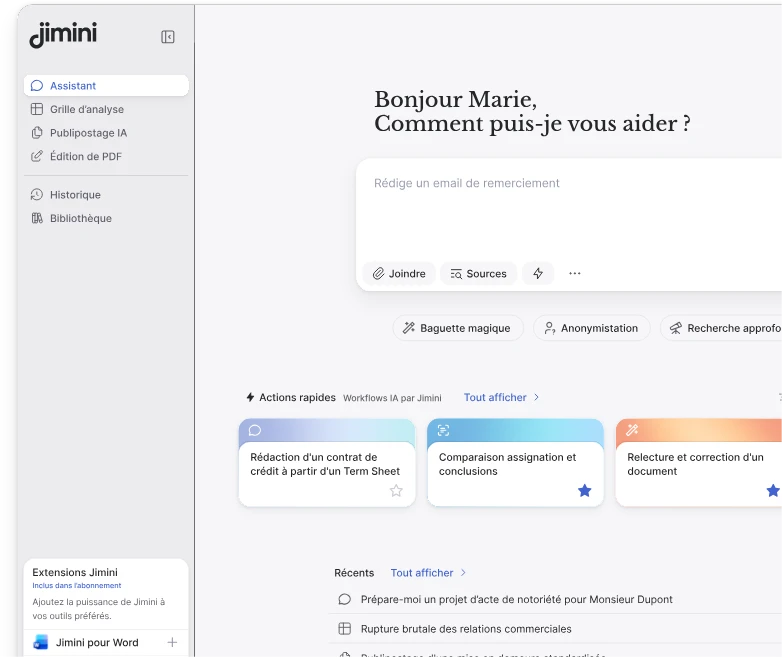
Jimini AI’s vision of its use
AI is not an isolated entity performing tasks in a vacuum. It is a living system that:
- changes the structure of legal reasoning, invites new working methods and reshapes how time is managed within law firms and legal departments;
- only “knows” what legal professionals teach it. It is the reflection of our data, our case law and, above all, the ethical and professional rules we impose on it.
This socio-technical approach is at the heart of Jimini’s vision. We do not see AI as a technological “black box” parachuted into a legal environment, but as a productivity assistant integrated into the firm’s ecosystem. It must not only perform well technically; it must be able to reason like a civil-law lawyer, compliant and aligned with the standards of legal practice.
What are the benefits for legal professionals?
Artificial intelligence can be a driver of competitiveness, agility and security for legal professionals. Properly integrated into legal processes, it delivers tangible benefits at every level of practice.
Optimising time and productivity
One of the first benefits is time savings. Whether it is proofreading documents, legal research or drafting, AI makes it possible to automate or speed up time-consuming tasks.
The result: legal professionals devote more time to analysis, strategy and client relationships, the true core of their work.
Reducing legal costs
By improving turnaround times, reducing reliance on external providers for certain standardised tasks and optimising document management, AI enables better control of legal budgets.
For legal departments, it also means finer-grained management of internal resources.
Improving quality and traceability
AI helps make the content produced more reliable (fewer errors, automatic verification of compliance points) and structures knowledge: everything is recorded, accessible and traceable.
An asset for audits, inspections, or building internal knowledge from case files.
Greater accessibility of legal information
Through conversational interfaces, intelligent search engines and visual dashboards, AI makes legal information more readable, more intuitive and faster to find.
This fosters a better understanding of the law, including for non-legal audiences such as business teams in companies or a law firm’s clients.
Towards the democratisation of law
AI also plays a role in access to justice: guidance tools, rights simulators, informational chatbots… These solutions allow more people to access reliable information outside the traditional channels.
It is a step towards a justice system that is more inclusive, more evenly distributed and better understood.
In short, legal artificial intelligence takes nothing away from the professional’s role: it expands it, secures it and enhances it, by handling everything that does not require human intuition, subtlety or judgment.
Limits, ethical challenges and responsibilities
The importance of human oversight
However powerful it may be, AI replaces neither legal reasoning nor judgment. It relies on statistical models, not on a capacity for interpretation in the legal sense of the term.
The legal professional remains the guarantor of the quality, relevance and accountability of the decisions made. AI is only an assistive tool.
Algorithmic bias and content reliability
Like any AI system, legal solutions can reproduce biases present in the training data, or generate content that is imprecise or even inappropriate.
Hence the need for systematic verification by a professional and an internal validation process.
Confidentiality and security of legal data
The data handled in the legal sector is sensitive by nature: confidential contracts, ongoing disputes, defence strategies…
Any legal AI solution must guarantee rigorous encryption, data sovereignty (local hosting, no uncontrolled transfers), and strict GDPR compliance.
Transparency and auditability of algorithms
It is essential to be able to understand, explain and document the results produced by an AI system.
This means working with technologies that are traceable, auditable and capable of justifying their recommendations, particularly in regulatory or litigation contexts.
Legal liability in the event of an error
If AI-generated content is misused or misinterpreted, who is at fault? The user? The software vendor? The developer?
Clarifying liability is a legal undertaking in itself, and requires everyone to clearly define the scopes of use and validation.
Regulatory and ethical challenges
As the 2024 European AI Act reminds us, certain uses of legal AI call for heightened vigilance. Particularly when decision-making processes affecting fundamental rights are automated. The risk of errors or biases amplified by the tool requires human oversight at every stage of the process.
Ethical standards, for their part, play an essential role: they provide guidance where the law is absent or insufficient. These standards generally translate into fundamental principles to be respected, such as transparency, non-discrimination, respect for privacy, security and inclusion.
How to choose your legal AI solution?
The most effective legal AI solutions are those that can be tailored to each organisation’s specific processes and objectives. A bespoke AI, trained on internal data, delivers more relevant answers, better-contextualised recommendations and smoother integration into legal professionals’ daily work.
To make sure you choose the right tool, several criteria should be examined:
- The information produced by the AI must be legally sound, sourced, verifiable and up to date.
- Compliance with the rules governing the processing of sensitive data, ethical obligations and the GDPR is essential.
- It must be possible to understand which data and which reasoning the AI relied on to produce its answers.
- The solution must be able to communicate with existing tools in order to streamline workflows.
Beyond the tool itself, the success of an AI project depends on upskilling the teams. The solution’s vendor must be able to offer support with onboarding, ongoing training and educational resources to ensure smooth adoption. The tool’s ergonomics, the clarity of its interface and its ability to explain the results it generates are all factors in successful adoption.
Finally, digital sovereignty is becoming a strategic issue. This is why more and more legal players are choosing solutions developed locally, hosted on French or European servers, and subject to strict security standards. This criterion is becoming a differentiator, particularly in public procurement or sensitive sectors.
Choosing a legal AI therefore means opting for a solution aligned with business requirements, performance expectations, and the ethical and regulatory imperatives of the law.
A lasting, but measured, transformation of the legal professions
Artificial intelligence is profoundly redefining professional roles. Yet it also raises fundamental questions: can a profession built on speech, deliberation and interpretation be turned into a mere sequence of automated procedures? Human intelligence remains irreplaceable when it comes to listening, judging and contextualising.
The augmented legal professional
Thanks to AI, legal professionals can refocus on strategic analysis, client relationships and tailored advice. They gain in efficiency, but also in quality of work life.
Far from devaluing human skills, AI strengthens their reach: rigor, judgment, negotiation and ethical vision remain irreplaceable.
New skills and hybrid profiles
This shift involves acquiring new skills:
- understanding machine learning technologies;
- mastering digital legal tools;
- the ability to collaborate with non-legal profiles (data, IT, innovation).
Law is becoming a multidisciplinary field, where working across disciplines becomes an asset.
Human - AI collaboration in everyday work
In this new way of working, AI is seen as a digital teammate: it executes, alerts and suggests, but does not decide on its own. The professional remains in control, and learns to steer an environment of intelligent tools to gain impact and value.
Towards a more agile legal culture
The adoption of AI goes hand in hand with a broader transformation:
- breaking down silos;
- improving the flow of information;
- the rise of legal ops (Legal Operations Officer);
- the evolution of legal business models.
The entire culture of legal practice is adapting: more fluid, more collaborative, more results-oriented.
Jimini is part of this drive for lasting transformation: our mission is to support legal professionals through this evolution, with tools that are reliable, ethical and built to last.
The future of law will be neither entirely human nor entirely technological. It will be hybrid, collaborative, controlled and profoundly enriched by artificial intelligence.