'%3e%3crect%20width='52'%20height='40'%20rx='10'%20fill='%23FFEA96'/%3e%3cg%20clip-path='url(%23clip1_2569_1375)'%3e%3crect%20width='59.0741'%20height='44'%20transform='translate(-3%20-4)'%20fill='%23A4ECF6'/%3e%3cg%20filter='url(%23filter0_f_2569_1375)'%3e%3cellipse%20cx='-10.3274'%20cy='7.80296'%20rx='36.4924'%20ry='39.2338'%20transform='rotate(11.6674%20-10.3274%207.80296)'%20fill='%23DDE2FF'/%3e%3cellipse%20cx='-10.3274'%20cy='7.80296'%20rx='36.4924'%20ry='39.2338'%20transform='rotate(11.6674%20-10.3274%207.80296)'%20stroke='%238FA6EB'%20stroke-width='21.4144'/%3e%3c/g%3e%3c/g%3e%3cpath%20d='M15.5%2029.3333L17.0167%2024.7833C14.3053%2020.7735%2015.353%2015.5993%2019.4667%2012.6803C23.5803%209.7625%2029.4883%2010.0017%2033.2858%2013.2403C37.0833%2016.4802%2037.5967%2021.7173%2034.4863%2025.4915C31.376%2029.2657%2025.6022%2030.409%2020.9833%2028.1667L15.5%2029.3333Z'%20stroke='white'%20stroke-width='1.5'%20stroke-linecap='round'%20stroke-linejoin='round'/%3e%3c/g%3e%3cdefs%3e%3cfilter%20id='filter0_f_2569_1375'%20x='-78.1925'%20y='-62.604'%20width='135.73'%20height='140.814'%20filterUnits='userSpaceOnUse'%20color-interpolation-filters='sRGB'%3e%3cfeFlood%20flood-opacity='0'%20result='BackgroundImageFix'/%3e%3cfeBlend%20mode='normal'%20in='SourceGraphic'%20in2='BackgroundImageFix'%20result='shape'/%3e%3cfeGaussianBlur%20stdDeviation='10.2764'%20result='effect1_foregroundBlur_2569_1375'/%3e%3c/filter%3e%3cclipPath%20id='clip0_2569_1375'%3e%3crect%20width='52'%20height='40'%20rx='10'%20fill='white'/%3e%3c/clipPath%3e%3cclipPath%20id='clip1_2569_1375'%3e%3crect%20width='59.0741'%20height='44'%20fill='white'%20transform='translate(-3%20-4)'/%3e%3c/clipPath%3e%3c/defs%3e%3c/svg%3e)
'%3e%3crect%20width='52'%20height='40'%20rx='10'%20fill='%23FFEA96'/%3e%3cg%20clip-path='url(%23clip1_2569_15019)'%3e%3crect%20width='84'%20height='42'%20transform='translate(-2%20-1)'%20fill='%2379BB84'/%3e%3cg%20filter='url(%23filter0_f_2569_15019)'%3e%3cellipse%20cx='51.2293'%20cy='24.9396'%20rx='37.103'%20ry='27.6663'%20transform='rotate(140.546%2051.2293%2024.9396)'%20fill='%2375D0AA'/%3e%3cellipse%20cx='51.2293'%20cy='24.9396'%20rx='37.103'%20ry='27.6663'%20transform='rotate(140.546%2051.2293%2024.9396)'%20stroke='%23A5E5AB'%20stroke-width='26'/%3e%3c/g%3e%3c/g%3e%3cpath%20d='M15.5%2017.6667H36.5M23.6667%209.5V30.5M15.5%2011.8333C15.5%2011.2145%2015.7458%2010.621%2016.1834%2010.1834C16.621%209.74583%2017.2145%209.5%2017.8333%209.5H34.1667C34.7855%209.5%2035.379%209.74583%2035.8166%2010.1834C36.2542%2010.621%2036.5%2011.2145%2036.5%2011.8333V28.1667C36.5%2028.7855%2036.2542%2029.379%2035.8166%2029.8166C35.379%2030.2542%2034.7855%2030.5%2034.1667%2030.5H17.8333C17.2145%2030.5%2016.621%2030.2542%2016.1834%2029.8166C15.7458%2029.379%2015.5%2028.7855%2015.5%2028.1667V11.8333Z'%20stroke='white'%20stroke-width='1.5'%20stroke-linecap='round'%20stroke-linejoin='round'/%3e%3c/g%3e%3cdefs%3e%3cfilter%20id='filter0_f_2569_15019'%20x='-8.68196'%20y='-33.1753'%20width='119.823'%20height='116.23'%20filterUnits='userSpaceOnUse'%20color-interpolation-filters='sRGB'%3e%3cfeFlood%20flood-opacity='0'%20result='BackgroundImageFix'/%3e%3cfeBlend%20mode='normal'%20in='SourceGraphic'%20in2='BackgroundImageFix'%20result='shape'/%3e%3cfeGaussianBlur%20stdDeviation='6.65'%20result='effect1_foregroundBlur_2569_15019'/%3e%3c/filter%3e%3cclipPath%20id='clip0_2569_15019'%3e%3crect%20width='52'%20height='40'%20rx='10'%20fill='white'/%3e%3c/clipPath%3e%3cclipPath%20id='clip1_2569_15019'%3e%3crect%20width='84'%20height='42'%20fill='white'%20transform='translate(-2%20-1)'/%3e%3c/clipPath%3e%3c/defs%3e%3c/svg%3e)
'%3e%3crect%20width='52'%20height='40'%20rx='10'%20fill='%23FFEA96'/%3e%3cg%20clip-path='url(%23clip1_2569_362)'%3e%3crect%20width='80'%20height='40'%20fill='%23D79BA2'/%3e%3cg%20filter='url(%23filter0_f_2569_362)'%3e%3cellipse%20cx='88.9522'%20cy='26.2192'%20rx='52.3951'%20ry='72.8474'%20transform='rotate(36.0726%2088.9522%2026.2192)'%20fill='%23B6CDEA'/%3e%3cellipse%20cx='88.9522'%20cy='26.2192'%20rx='52.3951'%20ry='72.8474'%20transform='rotate(36.0726%2088.9522%2026.2192)'%20stroke='%23829BB8'%20stroke-width='27'/%3e%3c/g%3e%3c/g%3e%3cpath%20d='M29.5%209.5V14.1667C29.5%2014.4761%2029.6229%2014.7728%2029.8417%2014.9916C30.0605%2015.2104%2030.3572%2015.3333%2030.6666%2015.3333H35.3333M35.3333%2015.3333L29.5%209.5H24.8333C24.2145%209.5%2023.621%209.74583%2023.1834%2010.1834C22.7458%2010.621%2022.5%2011.2145%2022.5%2011.8333V23.5C22.5%2024.1188%2022.7458%2024.7123%2023.1834%2025.1499C23.621%2025.5875%2024.2145%2025.8333%2024.8333%2025.8333H33C33.6188%2025.8333%2034.2123%2025.5875%2034.6499%2025.1499C35.0875%2024.7123%2035.3333%2024.1188%2035.3333%2023.5V15.3333ZM30.6666%2025.8333V28.1667C30.6666%2028.7855%2030.4208%2029.379%2029.9832%2029.8166C29.5456%2030.2542%2028.9522%2030.5%2028.3333%2030.5H20.1666C19.5478%2030.5%2018.9543%2030.2542%2018.5167%2029.8166C18.0791%2029.379%2017.8333%2028.7855%2017.8333%2028.1667V16.5C17.8333%2015.8812%2018.0791%2015.2877%2018.5167%2014.8501C18.9543%2014.4125%2019.5478%2014.1667%2020.1666%2014.1667H22.5'%20stroke='white'%20stroke-width='1.5'%20stroke-linecap='round'%20stroke-linejoin='round'/%3e%3c/g%3e%3cdefs%3e%3cfilter%20id='filter0_f_2569_362'%20x='-15.6247'%20y='-84.562'%20width='209.154'%20height='221.562'%20filterUnits='userSpaceOnUse'%20color-interpolation-filters='sRGB'%3e%3cfeFlood%20flood-opacity='0'%20result='BackgroundImageFix'/%3e%3cfeBlend%20mode='normal'%20in='SourceGraphic'%20in2='BackgroundImageFix'%20result='shape'/%3e%3cfeGaussianBlur%20stdDeviation='15.4'%20result='effect1_foregroundBlur_2569_362'/%3e%3c/filter%3e%3cclipPath%20id='clip0_2569_362'%3e%3crect%20width='52'%20height='40'%20rx='10'%20fill='white'/%3e%3c/clipPath%3e%3cclipPath%20id='clip1_2569_362'%3e%3crect%20width='80'%20height='40'%20fill='white'/%3e%3c/clipPath%3e%3c/defs%3e%3c/svg%3e)
'%3e%3crect%20width='52'%20height='40'%20rx='10'%20fill='%23FFEA96'/%3e%3cg%20clip-path='url(%23clip1_2569_6710)'%3e%3crect%20width='80'%20height='40'%20transform='translate(-15)'%20fill='%233D8E9C'/%3e%3cg%20filter='url(%23filter0_f_2569_6710)'%3e%3cellipse%20cx='32.2505'%20cy='16.4558'%20rx='51.5307'%20ry='23.1466'%20transform='rotate(50.2591%2032.2505%2016.4558)'%20fill='%2364E7DE'/%3e%3cpath%20d='M44.5377%206.2394C53.1416%2016.5878%2058.8151%2027.267%2061.2268%2035.9325C63.8373%2045.3129%2062.0035%2049.4129%2060.6132%2050.5689C59.2229%2051.7249%2054.8566%2052.7803%2046.11%2048.501C38.0303%2044.548%2028.5662%2037.0204%2019.9623%2026.672C11.3585%2016.3236%205.68548%205.64501%203.27384%20-3.02044C0.663075%20-12.4014%202.49786%20-16.5016%203.88815%20-17.6575C5.27854%20-18.8134%209.64428%20-19.868%2018.3906%20-15.5889C26.4702%20-11.6359%2035.9338%20-4.10886%2044.5377%206.2394Z'%20stroke='%234ECDC4'%20stroke-width='14.3333'/%3e%3c/g%3e%3c/g%3e%3cpath%20d='M20.1667%2029.3333H31.8333M19%2013L26%2011.8333L33%2013M19%2013L22.5%2020C22.5%2020.9283%2022.1313%2021.8185%2021.4749%2022.4749C20.8185%2023.1313%2019.9283%2023.5%2019%2023.5C18.0717%2023.5%2017.1815%2023.1313%2016.5251%2022.4749C15.8687%2021.8185%2015.5%2020.9283%2015.5%2020L19%2013ZM33%2013L36.5%2020C36.5%2020.9283%2036.1313%2021.8185%2035.4749%2022.4749C34.8185%2023.1313%2033.9283%2023.5%2033%2023.5C32.0717%2023.5%2031.1815%2023.1313%2030.5251%2022.4749C29.8687%2021.8185%2029.5%2020.9283%2029.5%2020L33%2013ZM26%209.5V29.3333'%20stroke='white'%20stroke-width='1.5'%20stroke-linecap='round'%20stroke-linejoin='round'/%3e%3c/g%3e%3cdefs%3e%3cfilter%20id='filter0_f_2569_6710'%20x='-18.2683'%20y='-38.9196'%20width='101.038'%20height='110.751'%20filterUnits='userSpaceOnUse'%20color-interpolation-filters='sRGB'%3e%3cfeFlood%20flood-opacity='0'%20result='BackgroundImageFix'/%3e%3cfeBlend%20mode='normal'%20in='SourceGraphic'%20in2='BackgroundImageFix'%20result='shape'/%3e%3cfeGaussianBlur%20stdDeviation='6.53333'%20result='effect1_foregroundBlur_2569_6710'/%3e%3c/filter%3e%3cclipPath%20id='clip0_2569_6710'%3e%3crect%20width='52'%20height='40'%20rx='10'%20fill='white'/%3e%3c/clipPath%3e%3cclipPath%20id='clip1_2569_6710'%3e%3crect%20width='80'%20height='40'%20fill='white'%20transform='translate(-15)'/%3e%3c/clipPath%3e%3c/defs%3e%3c/svg%3e)
'%3e%3crect%20width='52'%20height='40'%20rx='10'%20fill='%23FFEA96'/%3e%3cg%20clip-path='url(%23clip1_2569_4656)'%3e%3crect%20width='100'%20height='50'%20transform='translate(-24%20-4)'%20fill='%238D8DCF'/%3e%3cg%20filter='url(%23filter0_f_2569_4656)'%3e%3cellipse%20cx='16.4735'%20cy='40.123'%20rx='70.3864'%20ry='33.942'%20transform='rotate(-179.853%2016.4735%2040.123)'%20fill='%23D6C6FF'/%3e%3cpath%20d='M16.4056%2066.4097C-2.13768%2066.3619%20-18.5399%2062.679%20-30.016%2057.1085C-42.0318%2051.276%20-46.2693%2044.7259%20-46.2571%2039.9612C-46.2446%2035.1965%20-41.9732%2028.6691%20-29.9279%2022.8987C-18.4234%2017.3873%20-2.00237%2013.7889%2016.5409%2013.8366C35.084%2013.8843%2051.4863%2017.5673%2062.9624%2023.1377C74.978%2028.9701%2079.2165%2035.5194%2079.2045%2040.2841C79.1922%2045.0488%2074.9201%2051.577%2062.8743%2057.3476C51.3697%2062.8588%2034.9487%2066.4574%2016.4056%2066.4097Z'%20stroke='%239B89EE'%20stroke-width='15.311'/%3e%3c/g%3e%3c/g%3e%3cpath%20d='M28.3333%209.5V14.1667C28.3333%2014.4761%2028.4563%2014.7728%2028.6751%2014.9916C28.8938%2015.2104%2029.1906%2015.3333%2029.5%2015.3333H34.1667M34.1667%2020V15.3333L28.3333%209.5H20.1667C19.5478%209.5%2018.9543%209.74583%2018.5168%2010.1834C18.0792%2010.621%2017.8333%2011.2145%2017.8333%2011.8333V20M17.8333%2027H19.5833C20.0475%2027%2020.4926%2026.8156%2020.8208%2026.4874C21.149%2026.1592%2021.3333%2025.7141%2021.3333%2025.25C21.3333%2024.7859%2021.149%2024.3408%2020.8208%2024.0126C20.4926%2023.6844%2020.0475%2023.5%2019.5833%2023.5H17.8333V30.5M31.8333%2027H34.1667M35.3333%2023.5H31.8333V30.5M24.8333%2023.5V30.5H26C26.6188%2030.5%2027.2123%2030.2542%2027.6499%2029.8166C28.0875%2029.379%2028.3333%2028.7855%2028.3333%2028.1667V25.8333C28.3333%2025.2145%2028.0875%2024.621%2027.6499%2024.1834C27.2123%2023.7458%2026.6188%2023.5%2026%2023.5H24.8333Z'%20stroke='white'%20stroke-width='1.5'%20stroke-linecap='round'%20stroke-linejoin='round'/%3e%3c/g%3e%3cdefs%3e%3cfilter%20id='filter0_f_2569_4656'%20x='-70.246'%20y='-10.1527'%20width='173.439'%20height='100.551'%20filterUnits='userSpaceOnUse'%20color-interpolation-filters='sRGB'%3e%3cfeFlood%20flood-opacity='0'%20result='BackgroundImageFix'/%3e%3cfeBlend%20mode='normal'%20in='SourceGraphic'%20in2='BackgroundImageFix'%20result='shape'/%3e%3cfeGaussianBlur%20stdDeviation='8.16667'%20result='effect1_foregroundBlur_2569_4656'/%3e%3c/filter%3e%3cclipPath%20id='clip0_2569_4656'%3e%3crect%20width='52'%20height='40'%20rx='10'%20fill='white'/%3e%3c/clipPath%3e%3cclipPath%20id='clip1_2569_4656'%3e%3crect%20width='100'%20height='50'%20fill='white'%20transform='translate(-24%20-4)'/%3e%3c/clipPath%3e%3c/defs%3e%3c/svg%3e)
'%3e%3crect%20width='52'%20height='40'%20rx='10'%20fill='%23FFEA96'/%3e%3cg%20clip-path='url(%23clip1_2569_4888)'%3e%3crect%20width='100'%20height='50'%20transform='translate(-24%20-4)'%20fill='%2386568A'/%3e%3cg%20filter='url(%23filter0_f_2569_4888)'%3e%3cellipse%20cx='22.6407'%20cy='24.5662'%20rx='70.3864'%20ry='17.9732'%20transform='rotate(-58.3133%2022.6407%2024.5662)'%20fill='%23F3B3F5'/%3e%3cellipse%20cx='22.6407'%20cy='24.5662'%20rx='70.3864'%20ry='17.9732'%20transform='rotate(-58.3133%2022.6407%2024.5662)'%20stroke='%23B97ACE'%20stroke-width='13'/%3e%3c/g%3e%3c/g%3e%3cpath%20d='M27.1667%209.5V17.6667H34.1667L24.8333%2030.5V22.3333H17.8333L27.1667%209.5Z'%20stroke='white'%20stroke-width='1.5'%20stroke-linecap='round'%20stroke-linejoin='round'/%3e%3c/g%3e%3cdefs%3e%3cfilter%20id='filter0_f_2569_4888'%20x='-38.5803'%20y='-57.283'%20width='122.442'%20height='163.698'%20filterUnits='userSpaceOnUse'%20color-interpolation-filters='sRGB'%3e%3cfeFlood%20flood-opacity='0'%20result='BackgroundImageFix'/%3e%3cfeBlend%20mode='normal'%20in='SourceGraphic'%20in2='BackgroundImageFix'%20result='shape'/%3e%3cfeGaussianBlur%20stdDeviation='7.35'%20result='effect1_foregroundBlur_2569_4888'/%3e%3c/filter%3e%3cclipPath%20id='clip0_2569_4888'%3e%3crect%20width='52'%20height='40'%20rx='10'%20fill='white'/%3e%3c/clipPath%3e%3cclipPath%20id='clip1_2569_4888'%3e%3crect%20width='100'%20height='50'%20fill='white'%20transform='translate(-24%20-4)'/%3e%3c/clipPath%3e%3c/defs%3e%3c/svg%3e)





LegalTech: definition, uses and impact on law
A contraction of legal technology, LegalTech refers to all digital technologies applied to the field of law. In recent years, these innovative solutions have changed the working methods of professionals as well as the expectations of customers.
Intended for lawyers, corporate lawyers, notaries, entrepreneurs (VSES/start-ups) and students, LegalTech is transforming law through automation, drafting assistance, contract management and access to legal resources. It is no longer a marginal phenomenon: it is a clear transformation that is modernising the legal sector and by extension its accessibility.
What is LegalTech?
This term encompasses a wide variety of solutions, ranging from automated contract drafting platforms to artificial intelligence-based legal analysis software.
Originally, the first LegalTech focused on the dematerialisation of certain simple legal procedures:
— business creation;
— drafting of statutes;
— trademark registration;
— etc.
Their promise was clear: to make the law faster, more accessible, and less expensive. But today, their field of action has expanded considerably, to include technical areas such as:
— regulatory compliance;
— document management;
— or even interprofessional collaboration.
The word LegalTech also refers to a cultural change: that of a more agile law, closer to entrepreneurial and technological logics, where customer relationships, process performance and data analysis become legal challenges in their own right.
Thus, talking about LegalTech also means referring to a global movement to transform law, in which technological innovation and new uses are constantly redefining the role of the lawyer and access to justice.
What are the services and tools offered by these legal technologies?
LegalTech offers a wide range of tools designed to simplify, accelerate and make reliable repetitive or complex legal tasks. Today, they cover the entire legal value chain.
Automation of legal documents
Many platforms allow automatic generation
— contracts;
— the T&Cs;
— statutes;
— standard letters from customizable templates.
These solutions reduce errors, ensure compliance with current standards, and free up valuable time for lawyers. Some integrate electronic signature or collaborative versioning functionalities.
Analysis and revision of contracts
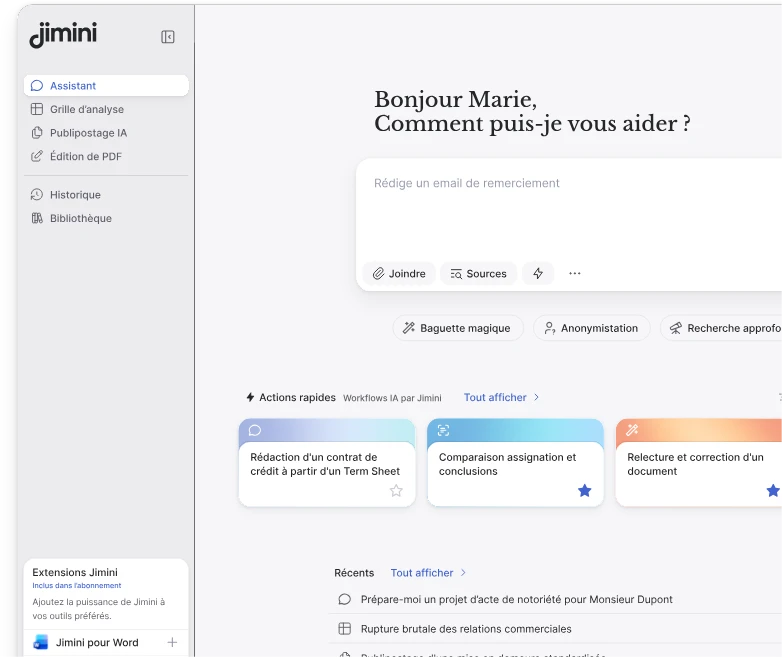
Thanks to artificial intelligence, some LegalTechs like Jimini AI assist professionals in reviewing contracts, by identifying risky clauses, oversights or inconsistencies. AI can also offer alternative formulations or produce a summary of the main points of attention, which involves decision-making and negotiation.
Contract cycle management (CLM)
Contract Lifecycle Management (CLM) solutions make it possible to follow the entire contractual process: from drafting to signing, then to archiving, including internal validations. These tools are often integrated with company information systems (ERP, CRM) and ensure complete traceability of exchanges.
Some applications also integrate blockchain technology to guarantee the integrity of documents, the tamper-proof timestamp of signatures or the implementation of smart contracts, which can be executed automatically according to predefined conditions.
Smart legal research
Some platforms offer documentary research enriched by AI, capable of quickly identifying applicable texts, relevant case law or doctrinal analyses, depending on the context or the question asked. A feature that is particularly valuable in environments with high regulatory pressure.
Compliance and risk management tools
Many LegalTechs support companies in complying with complex regulations:
— GDPR;
— Sapin II;
— anti-corruption…
All via risk mapping, regulatory alerts or register management solutions.
Online legal assistance and customer relationships
Other tools focus on improving client relationships in law firms or legal departments:
— appointment booking platforms;
— secure spaces for sharing documents;
— follow-up of files;
— chatbots capable of answering frequently asked legal questions.
Each type of service meets a specific business need, but all share the objective of making the practice of law more fluid, more transparent and more qualitative.
Who are they for?
Long perceived as tools reserved for legal start-ups or individual entrepreneurs, LegalTechs are now aimed at a wide variety of actors working in the private, institutional or liberal sector. Their adoption is becoming more widespread as the challenges of performance, compliance and digital transformation become central.
Lawyers and Law Firms
For bar professionals, LegalTechs offers concrete solutions to help with drafting, contractual revision, file management or customer relationships. They allow firms to better structure their activities, optimise their internal processes and differentiate themselves through a more fluid and responsive offer.
For example, automating the drafting of standard acts or the use of dynamic models significantly reduces production times. Coupled with intelligent case law research tools, LegalTech also facilitates the preparation of complex cases. Finally, the centralisation of client information in a secure space improves collaboration within the firm and reinforces the quality of the service provided and reduces the risk of errors or omissions.
Corporate Lawyers and Legal Departments
The digitalisation of the legal function is accelerating: according to a study conducted in 2025 by the Cercle Montesquieu, PwC Société d’Avocats and France Digitale, 71% of legal departments already use generative AI for their research and 30% for contract management. LegalTech are becoming extremely practical tools for securing processes, structuring the contractual cycle and interacting with other departments (finance, HR, compliance…).
Notaries, bailiffs, regulated professionals
Some legal professions subject to specific constraints (formalisms, authentic acts, conservation requirements) also benefit from dedicated solutions. Qualified electronic signature, archiving with probative value, management of remote appointments or processing of dematerialised acts… LegalTech adapts to these uses while respecting regulatory standards.
Entrepreneurs, VSEs and start-ups
Many platforms now make it possible to manage legal needs without immediately mobilising a lawyer: creating a business, drafting documents, compliance assistance. These tools meet a double expectation: autonomy and cost control and guarantee a solid legal framework.
Students, Young Professionals and Consultants
Finally, LegalTech also represents an educational and professional asset for new generations of lawyers. Some platforms offer simulators, training content, or collaborative work environments designed for learning and experimentation.
But beyond experimentation, mastering these tools is becoming an indispensable skill in academic and professional careers. Many law schools and training courses are now integrating LegalTech into their curriculum, whether through dedicated courses, certifications or practical workshops. Young lawyers are thus trained in the use of technologies as early as their studies, and expected to have these skills as soon as they enter the market. This generation, familiar with AI, collaborative platforms or document automation systems, is called upon to play a driving role in the digital transformation of the profession.
What is the impact of LegalTech on legal professions?
This mutation redefines expected skills, human-machine relationships, the posture of the lawyer, and requires increased reflection on ethics and digital responsibility.
New skills expected: tech, data, AI
Lawyers can no longer be satisfied with purely legal expertise. They must also:
— understand the logic of algorithms;
— manipulating structured data;
— dialogue with developers;
— guarantee the implementation of legal rules in technological environments.
This hybridisation of skills is proving to be decisive, especially in legal departments in full digitalisation.
A human-machine collaboration
Generative AI or predictive analysis engines are not intended to replace lawyers, but to assist them. This human-machine cooperation redistributes roles and enhances human skills.
AI and automation tools are taking on a growing number of low value-added, but essential tasks:
-
Algorithms analyse thousands of decisions, contracts, or regulatory texts in seconds, reducing the time spent on legal intelligence.
-
Generative AI (such as legal chatbots or drafting tools) produces draft contracts, case law summaries, or risk classifications, freeing lawyers from basic writing tasks.
-
They also facilitate due diligence with predictive analysis platforms that automatically identify risky clauses or inconsistencies in volumes of documents to improve the accuracy and speed of audits.
The lawyer is no longer perceived as an executor, but as a business partner, capable of anticipating risks and proposing creative solutions. The emergence of hybrid profiles (legal ops, legal engineers, data lawyers) illustrates this evolution towards a more diversified and tech-savvy profession.
Digital Ethics and the Duty to Set an Example
This transformation comes with new requirements. As Thomas Saint-Aubin (IRJS — Sorbonne) points out, LegalTechs cannot ignore the ethical principles that underlie the legal professions. In a context where the European Union promotes an ethical digital economy (via texts such as the DSA and the DMA), and where a European Declaration of Digital Rights and Principles was published in January 2022, lawyers have an increased responsibility.
The founders of LegalTech from the legal world have a double obligation: technical and ethical. They are called upon to:
— design technologies that respect fundamental freedoms;
— keep the human being at the centre;
— anticipate future European digital governance standards.
A requirement of ethical compliance that is a differentiating factor compared to other technological models, in particular North American or Asian, which are less focused on regulation.
Managing risks: bias, security, transparency
The use of AI in law also raises ethical questions: algorithmic biases, opacity of automated decisions, risks in terms of confidentiality or the use of personal data. The lawyer must not only master the tools, but also remain responsible for their own use, in compliance with the GDPR, professional secrecy, and the fundamental values of law.