'%3e%3crect%20width='52'%20height='40'%20rx='10'%20fill='%23FFEA96'/%3e%3cg%20clip-path='url(%23clip1_2569_1375)'%3e%3crect%20width='59.0741'%20height='44'%20transform='translate(-3%20-4)'%20fill='%23A4ECF6'/%3e%3cg%20filter='url(%23filter0_f_2569_1375)'%3e%3cellipse%20cx='-10.3274'%20cy='7.80296'%20rx='36.4924'%20ry='39.2338'%20transform='rotate(11.6674%20-10.3274%207.80296)'%20fill='%23DDE2FF'/%3e%3cellipse%20cx='-10.3274'%20cy='7.80296'%20rx='36.4924'%20ry='39.2338'%20transform='rotate(11.6674%20-10.3274%207.80296)'%20stroke='%238FA6EB'%20stroke-width='21.4144'/%3e%3c/g%3e%3c/g%3e%3cpath%20d='M15.5%2029.3333L17.0167%2024.7833C14.3053%2020.7735%2015.353%2015.5993%2019.4667%2012.6803C23.5803%209.7625%2029.4883%2010.0017%2033.2858%2013.2403C37.0833%2016.4802%2037.5967%2021.7173%2034.4863%2025.4915C31.376%2029.2657%2025.6022%2030.409%2020.9833%2028.1667L15.5%2029.3333Z'%20stroke='white'%20stroke-width='1.5'%20stroke-linecap='round'%20stroke-linejoin='round'/%3e%3c/g%3e%3cdefs%3e%3cfilter%20id='filter0_f_2569_1375'%20x='-78.1925'%20y='-62.604'%20width='135.73'%20height='140.814'%20filterUnits='userSpaceOnUse'%20color-interpolation-filters='sRGB'%3e%3cfeFlood%20flood-opacity='0'%20result='BackgroundImageFix'/%3e%3cfeBlend%20mode='normal'%20in='SourceGraphic'%20in2='BackgroundImageFix'%20result='shape'/%3e%3cfeGaussianBlur%20stdDeviation='10.2764'%20result='effect1_foregroundBlur_2569_1375'/%3e%3c/filter%3e%3cclipPath%20id='clip0_2569_1375'%3e%3crect%20width='52'%20height='40'%20rx='10'%20fill='white'/%3e%3c/clipPath%3e%3cclipPath%20id='clip1_2569_1375'%3e%3crect%20width='59.0741'%20height='44'%20fill='white'%20transform='translate(-3%20-4)'/%3e%3c/clipPath%3e%3c/defs%3e%3c/svg%3e)
'%3e%3crect%20width='52'%20height='40'%20rx='10'%20fill='%23FFEA96'/%3e%3cg%20clip-path='url(%23clip1_2569_15019)'%3e%3crect%20width='84'%20height='42'%20transform='translate(-2%20-1)'%20fill='%2379BB84'/%3e%3cg%20filter='url(%23filter0_f_2569_15019)'%3e%3cellipse%20cx='51.2293'%20cy='24.9396'%20rx='37.103'%20ry='27.6663'%20transform='rotate(140.546%2051.2293%2024.9396)'%20fill='%2375D0AA'/%3e%3cellipse%20cx='51.2293'%20cy='24.9396'%20rx='37.103'%20ry='27.6663'%20transform='rotate(140.546%2051.2293%2024.9396)'%20stroke='%23A5E5AB'%20stroke-width='26'/%3e%3c/g%3e%3c/g%3e%3cpath%20d='M15.5%2017.6667H36.5M23.6667%209.5V30.5M15.5%2011.8333C15.5%2011.2145%2015.7458%2010.621%2016.1834%2010.1834C16.621%209.74583%2017.2145%209.5%2017.8333%209.5H34.1667C34.7855%209.5%2035.379%209.74583%2035.8166%2010.1834C36.2542%2010.621%2036.5%2011.2145%2036.5%2011.8333V28.1667C36.5%2028.7855%2036.2542%2029.379%2035.8166%2029.8166C35.379%2030.2542%2034.7855%2030.5%2034.1667%2030.5H17.8333C17.2145%2030.5%2016.621%2030.2542%2016.1834%2029.8166C15.7458%2029.379%2015.5%2028.7855%2015.5%2028.1667V11.8333Z'%20stroke='white'%20stroke-width='1.5'%20stroke-linecap='round'%20stroke-linejoin='round'/%3e%3c/g%3e%3cdefs%3e%3cfilter%20id='filter0_f_2569_15019'%20x='-8.68196'%20y='-33.1753'%20width='119.823'%20height='116.23'%20filterUnits='userSpaceOnUse'%20color-interpolation-filters='sRGB'%3e%3cfeFlood%20flood-opacity='0'%20result='BackgroundImageFix'/%3e%3cfeBlend%20mode='normal'%20in='SourceGraphic'%20in2='BackgroundImageFix'%20result='shape'/%3e%3cfeGaussianBlur%20stdDeviation='6.65'%20result='effect1_foregroundBlur_2569_15019'/%3e%3c/filter%3e%3cclipPath%20id='clip0_2569_15019'%3e%3crect%20width='52'%20height='40'%20rx='10'%20fill='white'/%3e%3c/clipPath%3e%3cclipPath%20id='clip1_2569_15019'%3e%3crect%20width='84'%20height='42'%20fill='white'%20transform='translate(-2%20-1)'/%3e%3c/clipPath%3e%3c/defs%3e%3c/svg%3e)
'%3e%3crect%20width='52'%20height='40'%20rx='10'%20fill='%23FFEA96'/%3e%3cg%20clip-path='url(%23clip1_2569_362)'%3e%3crect%20width='80'%20height='40'%20fill='%23D79BA2'/%3e%3cg%20filter='url(%23filter0_f_2569_362)'%3e%3cellipse%20cx='88.9522'%20cy='26.2192'%20rx='52.3951'%20ry='72.8474'%20transform='rotate(36.0726%2088.9522%2026.2192)'%20fill='%23B6CDEA'/%3e%3cellipse%20cx='88.9522'%20cy='26.2192'%20rx='52.3951'%20ry='72.8474'%20transform='rotate(36.0726%2088.9522%2026.2192)'%20stroke='%23829BB8'%20stroke-width='27'/%3e%3c/g%3e%3c/g%3e%3cpath%20d='M29.5%209.5V14.1667C29.5%2014.4761%2029.6229%2014.7728%2029.8417%2014.9916C30.0605%2015.2104%2030.3572%2015.3333%2030.6666%2015.3333H35.3333M35.3333%2015.3333L29.5%209.5H24.8333C24.2145%209.5%2023.621%209.74583%2023.1834%2010.1834C22.7458%2010.621%2022.5%2011.2145%2022.5%2011.8333V23.5C22.5%2024.1188%2022.7458%2024.7123%2023.1834%2025.1499C23.621%2025.5875%2024.2145%2025.8333%2024.8333%2025.8333H33C33.6188%2025.8333%2034.2123%2025.5875%2034.6499%2025.1499C35.0875%2024.7123%2035.3333%2024.1188%2035.3333%2023.5V15.3333ZM30.6666%2025.8333V28.1667C30.6666%2028.7855%2030.4208%2029.379%2029.9832%2029.8166C29.5456%2030.2542%2028.9522%2030.5%2028.3333%2030.5H20.1666C19.5478%2030.5%2018.9543%2030.2542%2018.5167%2029.8166C18.0791%2029.379%2017.8333%2028.7855%2017.8333%2028.1667V16.5C17.8333%2015.8812%2018.0791%2015.2877%2018.5167%2014.8501C18.9543%2014.4125%2019.5478%2014.1667%2020.1666%2014.1667H22.5'%20stroke='white'%20stroke-width='1.5'%20stroke-linecap='round'%20stroke-linejoin='round'/%3e%3c/g%3e%3cdefs%3e%3cfilter%20id='filter0_f_2569_362'%20x='-15.6247'%20y='-84.562'%20width='209.154'%20height='221.562'%20filterUnits='userSpaceOnUse'%20color-interpolation-filters='sRGB'%3e%3cfeFlood%20flood-opacity='0'%20result='BackgroundImageFix'/%3e%3cfeBlend%20mode='normal'%20in='SourceGraphic'%20in2='BackgroundImageFix'%20result='shape'/%3e%3cfeGaussianBlur%20stdDeviation='15.4'%20result='effect1_foregroundBlur_2569_362'/%3e%3c/filter%3e%3cclipPath%20id='clip0_2569_362'%3e%3crect%20width='52'%20height='40'%20rx='10'%20fill='white'/%3e%3c/clipPath%3e%3cclipPath%20id='clip1_2569_362'%3e%3crect%20width='80'%20height='40'%20fill='white'/%3e%3c/clipPath%3e%3c/defs%3e%3c/svg%3e)
'%3e%3crect%20width='52'%20height='40'%20rx='10'%20fill='%23FFEA96'/%3e%3cg%20clip-path='url(%23clip1_2569_6710)'%3e%3crect%20width='80'%20height='40'%20transform='translate(-15)'%20fill='%233D8E9C'/%3e%3cg%20filter='url(%23filter0_f_2569_6710)'%3e%3cellipse%20cx='32.2505'%20cy='16.4558'%20rx='51.5307'%20ry='23.1466'%20transform='rotate(50.2591%2032.2505%2016.4558)'%20fill='%2364E7DE'/%3e%3cpath%20d='M44.5377%206.2394C53.1416%2016.5878%2058.8151%2027.267%2061.2268%2035.9325C63.8373%2045.3129%2062.0035%2049.4129%2060.6132%2050.5689C59.2229%2051.7249%2054.8566%2052.7803%2046.11%2048.501C38.0303%2044.548%2028.5662%2037.0204%2019.9623%2026.672C11.3585%2016.3236%205.68548%205.64501%203.27384%20-3.02044C0.663075%20-12.4014%202.49786%20-16.5016%203.88815%20-17.6575C5.27854%20-18.8134%209.64428%20-19.868%2018.3906%20-15.5889C26.4702%20-11.6359%2035.9338%20-4.10886%2044.5377%206.2394Z'%20stroke='%234ECDC4'%20stroke-width='14.3333'/%3e%3c/g%3e%3c/g%3e%3cpath%20d='M20.1667%2029.3333H31.8333M19%2013L26%2011.8333L33%2013M19%2013L22.5%2020C22.5%2020.9283%2022.1313%2021.8185%2021.4749%2022.4749C20.8185%2023.1313%2019.9283%2023.5%2019%2023.5C18.0717%2023.5%2017.1815%2023.1313%2016.5251%2022.4749C15.8687%2021.8185%2015.5%2020.9283%2015.5%2020L19%2013ZM33%2013L36.5%2020C36.5%2020.9283%2036.1313%2021.8185%2035.4749%2022.4749C34.8185%2023.1313%2033.9283%2023.5%2033%2023.5C32.0717%2023.5%2031.1815%2023.1313%2030.5251%2022.4749C29.8687%2021.8185%2029.5%2020.9283%2029.5%2020L33%2013ZM26%209.5V29.3333'%20stroke='white'%20stroke-width='1.5'%20stroke-linecap='round'%20stroke-linejoin='round'/%3e%3c/g%3e%3cdefs%3e%3cfilter%20id='filter0_f_2569_6710'%20x='-18.2683'%20y='-38.9196'%20width='101.038'%20height='110.751'%20filterUnits='userSpaceOnUse'%20color-interpolation-filters='sRGB'%3e%3cfeFlood%20flood-opacity='0'%20result='BackgroundImageFix'/%3e%3cfeBlend%20mode='normal'%20in='SourceGraphic'%20in2='BackgroundImageFix'%20result='shape'/%3e%3cfeGaussianBlur%20stdDeviation='6.53333'%20result='effect1_foregroundBlur_2569_6710'/%3e%3c/filter%3e%3cclipPath%20id='clip0_2569_6710'%3e%3crect%20width='52'%20height='40'%20rx='10'%20fill='white'/%3e%3c/clipPath%3e%3cclipPath%20id='clip1_2569_6710'%3e%3crect%20width='80'%20height='40'%20fill='white'%20transform='translate(-15)'/%3e%3c/clipPath%3e%3c/defs%3e%3c/svg%3e)
'%3e%3crect%20width='52'%20height='40'%20rx='10'%20fill='%23FFEA96'/%3e%3cg%20clip-path='url(%23clip1_2569_4656)'%3e%3crect%20width='100'%20height='50'%20transform='translate(-24%20-4)'%20fill='%238D8DCF'/%3e%3cg%20filter='url(%23filter0_f_2569_4656)'%3e%3cellipse%20cx='16.4735'%20cy='40.123'%20rx='70.3864'%20ry='33.942'%20transform='rotate(-179.853%2016.4735%2040.123)'%20fill='%23D6C6FF'/%3e%3cpath%20d='M16.4056%2066.4097C-2.13768%2066.3619%20-18.5399%2062.679%20-30.016%2057.1085C-42.0318%2051.276%20-46.2693%2044.7259%20-46.2571%2039.9612C-46.2446%2035.1965%20-41.9732%2028.6691%20-29.9279%2022.8987C-18.4234%2017.3873%20-2.00237%2013.7889%2016.5409%2013.8366C35.084%2013.8843%2051.4863%2017.5673%2062.9624%2023.1377C74.978%2028.9701%2079.2165%2035.5194%2079.2045%2040.2841C79.1922%2045.0488%2074.9201%2051.577%2062.8743%2057.3476C51.3697%2062.8588%2034.9487%2066.4574%2016.4056%2066.4097Z'%20stroke='%239B89EE'%20stroke-width='15.311'/%3e%3c/g%3e%3c/g%3e%3cpath%20d='M28.3333%209.5V14.1667C28.3333%2014.4761%2028.4563%2014.7728%2028.6751%2014.9916C28.8938%2015.2104%2029.1906%2015.3333%2029.5%2015.3333H34.1667M34.1667%2020V15.3333L28.3333%209.5H20.1667C19.5478%209.5%2018.9543%209.74583%2018.5168%2010.1834C18.0792%2010.621%2017.8333%2011.2145%2017.8333%2011.8333V20M17.8333%2027H19.5833C20.0475%2027%2020.4926%2026.8156%2020.8208%2026.4874C21.149%2026.1592%2021.3333%2025.7141%2021.3333%2025.25C21.3333%2024.7859%2021.149%2024.3408%2020.8208%2024.0126C20.4926%2023.6844%2020.0475%2023.5%2019.5833%2023.5H17.8333V30.5M31.8333%2027H34.1667M35.3333%2023.5H31.8333V30.5M24.8333%2023.5V30.5H26C26.6188%2030.5%2027.2123%2030.2542%2027.6499%2029.8166C28.0875%2029.379%2028.3333%2028.7855%2028.3333%2028.1667V25.8333C28.3333%2025.2145%2028.0875%2024.621%2027.6499%2024.1834C27.2123%2023.7458%2026.6188%2023.5%2026%2023.5H24.8333Z'%20stroke='white'%20stroke-width='1.5'%20stroke-linecap='round'%20stroke-linejoin='round'/%3e%3c/g%3e%3cdefs%3e%3cfilter%20id='filter0_f_2569_4656'%20x='-70.246'%20y='-10.1527'%20width='173.439'%20height='100.551'%20filterUnits='userSpaceOnUse'%20color-interpolation-filters='sRGB'%3e%3cfeFlood%20flood-opacity='0'%20result='BackgroundImageFix'/%3e%3cfeBlend%20mode='normal'%20in='SourceGraphic'%20in2='BackgroundImageFix'%20result='shape'/%3e%3cfeGaussianBlur%20stdDeviation='8.16667'%20result='effect1_foregroundBlur_2569_4656'/%3e%3c/filter%3e%3cclipPath%20id='clip0_2569_4656'%3e%3crect%20width='52'%20height='40'%20rx='10'%20fill='white'/%3e%3c/clipPath%3e%3cclipPath%20id='clip1_2569_4656'%3e%3crect%20width='100'%20height='50'%20fill='white'%20transform='translate(-24%20-4)'/%3e%3c/clipPath%3e%3c/defs%3e%3c/svg%3e)
'%3e%3crect%20width='52'%20height='40'%20rx='10'%20fill='%23FFEA96'/%3e%3cg%20clip-path='url(%23clip1_2569_4888)'%3e%3crect%20width='100'%20height='50'%20transform='translate(-24%20-4)'%20fill='%2386568A'/%3e%3cg%20filter='url(%23filter0_f_2569_4888)'%3e%3cellipse%20cx='22.6407'%20cy='24.5662'%20rx='70.3864'%20ry='17.9732'%20transform='rotate(-58.3133%2022.6407%2024.5662)'%20fill='%23F3B3F5'/%3e%3cellipse%20cx='22.6407'%20cy='24.5662'%20rx='70.3864'%20ry='17.9732'%20transform='rotate(-58.3133%2022.6407%2024.5662)'%20stroke='%23B97ACE'%20stroke-width='13'/%3e%3c/g%3e%3c/g%3e%3cpath%20d='M27.1667%209.5V17.6667H34.1667L24.8333%2030.5V22.3333H17.8333L27.1667%209.5Z'%20stroke='white'%20stroke-width='1.5'%20stroke-linecap='round'%20stroke-linejoin='round'/%3e%3c/g%3e%3cdefs%3e%3cfilter%20id='filter0_f_2569_4888'%20x='-38.5803'%20y='-57.283'%20width='122.442'%20height='163.698'%20filterUnits='userSpaceOnUse'%20color-interpolation-filters='sRGB'%3e%3cfeFlood%20flood-opacity='0'%20result='BackgroundImageFix'/%3e%3cfeBlend%20mode='normal'%20in='SourceGraphic'%20in2='BackgroundImageFix'%20result='shape'/%3e%3cfeGaussianBlur%20stdDeviation='7.35'%20result='effect1_foregroundBlur_2569_4888'/%3e%3c/filter%3e%3cclipPath%20id='clip0_2569_4888'%3e%3crect%20width='52'%20height='40'%20rx='10'%20fill='white'/%3e%3c/clipPath%3e%3cclipPath%20id='clip1_2569_4888'%3e%3crect%20width='100'%20height='50'%20fill='white'%20transform='translate(-24%20-4)'/%3e%3c/clipPath%3e%3c/defs%3e%3c/svg%3e)




The complete guide to legal AI for law firms
How do you integrate AI into your law firm? Tools, use cases, GDPR compliance and best practices to boost productivity.
Artificial intelligence is steadily establishing itself as a structuring tool in the practice of the legal professions. Applied to legal work, it automates certain repetitive and time-consuming tasks, speeds up document research and analysis, and structures legal information more effectively.
Far from calling the lawyer’s role into question, AI acts as an assistance tool that reinforces human expertise and frees up time for high-value work: in-depth legal analysis, strategy, advisory work and the client relationship.
What is legal AI and how does it work in a law firm?
Legal AI refers to the full range of artificial intelligence tools designed to assist legal professionals in carrying out their work.
What data does AI draw on?
Applied to law, AI aims to analyse, understand and exploit large volumes of legal data — legislation, case law, legal scholarship, contracts — to make the lawyer’s work easier without ever replacing it.
Legal AI relieves lawyers and in-house counsel of repetitive, time-consuming tasks in case-file analysis, legal research and assisted drafting.
On the technology side, legal AI relies mainly on:
-
specialised language models capable of understanding legal structure and reasoning;
-
semantic-analysis technologies;
-
machine-learning systems trained on legal databases to detect patterns, compare situations and assist analysis.
Within a law firm, legal AI acts as an augmented legal assistant.
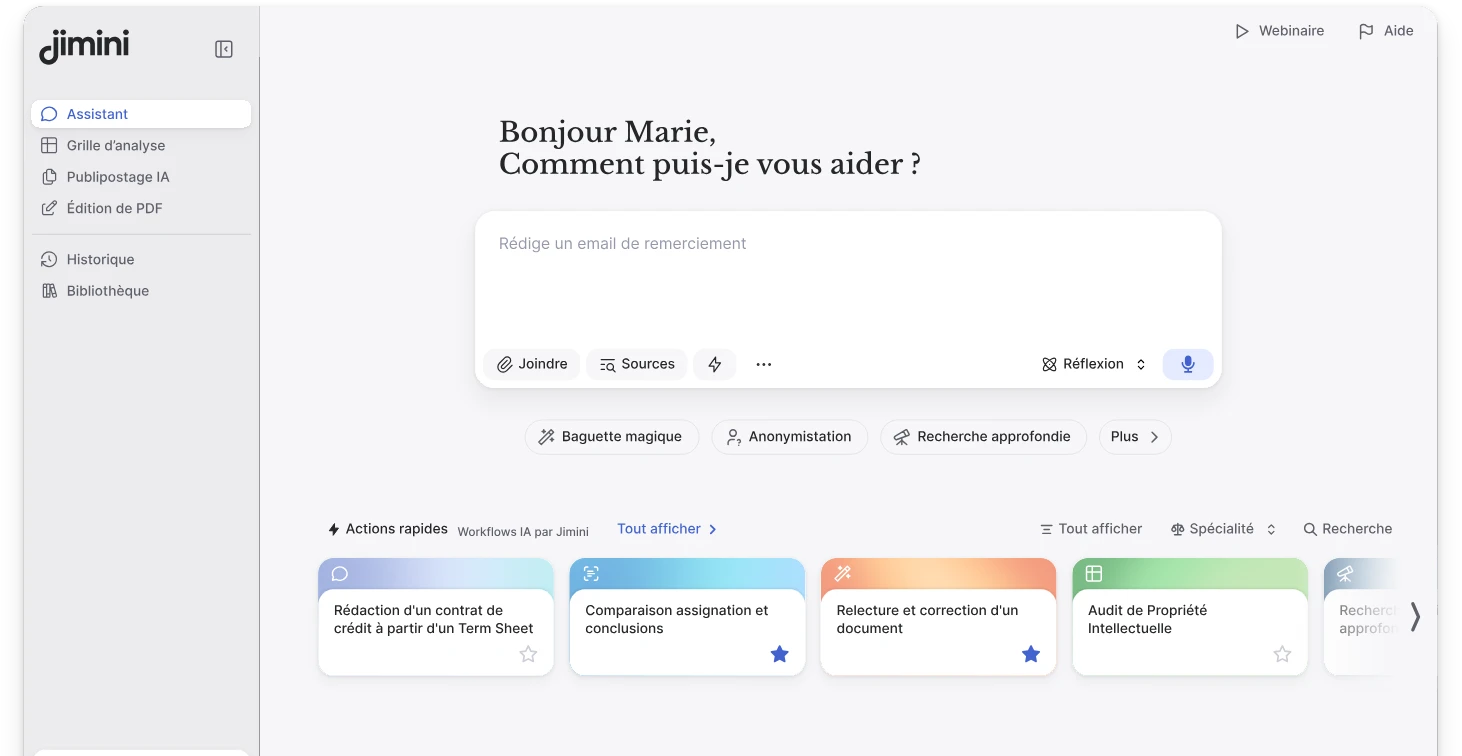
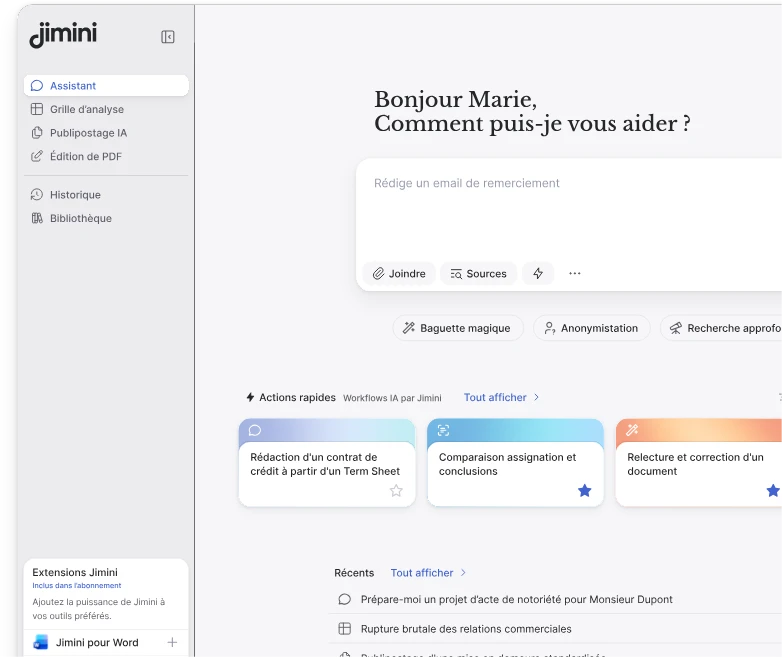
Jimini is designed as a true copilot for legal professionals, to:
-
speed up legal research;
-
make it easier to produce legal documents;
-
automate certain low-value legal tasks;
-
improve how the firm’s legal knowledge is structured and managed.
Legal AI is transforming legal practice, raising major operational questions while shaping the strategies of law firms and legal departments. Between performance, regulatory compliance and respect for professional ethics, legal artificial intelligence demands careful thinking about ethics, responsibility and data governance.
Legal AI offers significant potential gains in time and quality, provided it is used within a controlled legal framework that respects professional secrecy, the GDPR and the ethical and professional-conduct principles specific to the legal profession.
What are the main AI tools and solutions for law firms today?
The main legal AI software solutions fall into two broad categories:
AI-augmented legal research: a profound transformation of access to legal information
AI-powered legal research is profoundly transforming access to legal information within law firms. Drawing on legal publishers’ databases, open-source legal and legislative resources and artificial intelligence technologies, it enables faster, finer-grained and more relevant exploitation of the sources of law.
AI streamlines legal research by simultaneously analysing legislation, case law and legal scholarship, while identifying the relevant legal links between texts and decisions.
Thanks to advanced search, the lawyer can query the law in natural language, obtain contextualised results and access targeted summaries that can be used directly in their legal reasoning. Jimini’s legal artificial intelligence is trained on legal databases. If the request concerns drafting a summary of a commercial contract, Jimini can determine the legal elements that are priorities and necessary for the summary.
Integrated into the firm’s tools, legal research with Jimini becomes a lever for efficiency and quality, in the service of analysis, legal certainty and professional performance.
Legal-productivity AI systems: AI designed for firms’ real-world needs
Built in collaboration with law firms and legal departments, Jimini is designed to improve the productivity of legal professionals. *Legal productivity tools fall into several broad categories of task: *
Legal document analysis and data extraction
Legal AI enables semantic analysis and comprehension of large volumes of data, and therefore relevant data extraction.
Several tools are available for immediate time savings.
- **The summary tool **
It quickly condenses voluminous legal documents into clear, structured, directly usable information. It can produce either a page-by-page summary or an overall summary, depending on the level of detail the lawyer requires.
The page-by-page summary makes it easier to read complex documents in detail — court submissions, long contracts or bundles of exhibits — by highlighting, for each section, the essential legal points, the key arguments and the decisive factual elements.
The general summary, for its part, provides an overview of the document or corpus analysed. It quickly identifies the main issues, the underlying legal logic and the points requiring attention, without having to read through the entire content.
- **Document analysis **
It makes it possible to work efficiently with any type of legal document, whatever its format (PDF, Word, scans, mixed exhibits), automatically extracting the requested information.
It turns often voluminous and complex content into structured data that the lawyer can use directly.
- **The Analysis Grid **
It enables efficient side-by-side comparison of several legal documents by structuring the information around precise, consistent criteria. This tool makes it possible to identify differences and similarities between multiple documents quickly.
By centralising the essential information in a readable, structured format, the Analysis Grid helps the lawyer work more efficiently, secure their reasoning and reduce the risk of omission.
It is a particularly useful tool for audits, contract review, comparing successive versions of legal documents or analysing exhibits in litigation.
Every answer produced by Jimini’s tools is sourced and verifiable directly in the documents, always with productivity and time savings in mind for each user.
Production and drafting assistance
Legal AI automates legal tasks to improve efficiency in drafting emails, contracts and summaries, and in translation.
- **The Jimini for Word add-in **
This is a drafting assistant embedded directly in Word: this copilot helps you analyse, draft, correct and translate without leaving your document.
At every stage of legal production, repetitive tasks take less time.
- The AI Mail Merge tool
Starting from a template, the AI Mail Merge developed by Jimini automatically generates individualised legal documents from a single model. This feature makes it easy to mass-produce personalised legal documents while guaranteeing a high level of legal and drafting consistency.
By integrating variables specific to each matter, the content is adapted reliably and securely, with no manual re-entry required. AI Mail Merge thus significantly reduces the time spent on repetitive tasks and limits the risk of human error.
Finally, it is an essential efficiency lever for law firms that have to manage large volumes of standardised documents.
- Legal document translation
We support lawyers in their international matters: we guarantee fast, reliable translation for all your legal documents.
Advantages of the Jimini tool suite
Thanks to these tools, the productivity and efficiency of lawyers and associates are significantly strengthened, transforming how work is organised within law firms:
- Reduced risk of human error: AI limits manual data entry and copy-pasting. Overall consistency and correction help limit spelling mistakes, typos and omissions on the drafter’s part. For example, Jimini’s Magic Wand tool has on several occasions flagged the confusion between principals and agents to in-house counsel.
- Time savings and optimised legal research: AI speeds up the analysis of contracts and leases, the review of litigation chronologies, corporate and employment audits, the comparison of collective bargaining agreements and the processing of exhibits in litigation. It also enables faster, more targeted legal monitoring. These time savings come from AI’s ability to analyse large volumes of documents simultaneously, quickly identify the relevant information, automatically structure legal data and propose usable summaries.
- Lower operating costs: by automating repetitive tasks and optimising teams’ working time, AI contributes to better resource allocation, lower legal-production costs and more efficient matter management.
- Centralisation and rationalisation of tools: using integrated AI solutions optimises legal research through a single tool centralising access to information.
- A lasting boost to lawyers’ effectiveness: by refocusing legal professionals on high-value work — legal analysis, litigation strategy, advice and client management — AI becomes a structuring lever of performance and competitiveness for the firm.
Case study: how do you choose an AI tool suited to your law firm?
The choice of a legal AI tool cannot be one-size-fits-all: it must be guided by the firm’s actual needs, its specialisation and how it operates. A pragmatic, targeted approach is essential to ensure effective adoption and a real productivity gain:
-
Identify the firm’s needs precisely
-
Take account of the firm’s legal specialisation and the tool’s limits
-
Assess legal and technological reliability
- Identify the firm’s needs precisely
Before any selection, the concrete uses the AI will need to cover should be identified. Depending on the firm’s practice, needs may include:
-
augmented case-law and legal-scholarship research;
-
analysis of contracts and leases;
-
setting up document Analysis Grids for audits (corporate, employment, real estate);
-
assisted drafting of letters, contracts or legal documents;
-
summarising voluminous legal documents;
-
legal translation.
A relevant tool is above all a tool that addresses clearly identified, measurable use cases.
- Take account of the firm’s legal specialisation and the tool’s limits
Adapting legal AI to your firm’s needs starts with a fine-grained analysis of the tasks performed day to day, taking into account the specific features of each area of law.
The effectiveness of an artificial intelligence tool depends largely on its ability to fit into the firm’s existing practices and to address clearly identified operational problems.
Use case 1 — Litigation
In litigation, legal AI finds a particularly relevant application in analysing and comparing pleadings.
It makes it possible to set the writ of summons against the submissions in defence, then to compare successive sets of court submissions in order to quickly identify the new grounds, arguments or factual elements introduced by the opposing party.
As soon as new submissions arrive, tools like Jimini thus allow the lawyer to focus immediately on the most significant developments in the case, while limiting the time spent on repetitive reading.
Use case 2 — Real estate law
In real estate law, legal AI proves valuable for audits and contract analysis. The Analysis Grid tool makes it possible to review a set of commercial leases in a structured way, extract the key clauses and identify the points of legal concern.
This approach makes it easier to compare multiple documents and secures the legal reasoning, while improving the readability and traceability of the analyses performed.
Use case 3 — Business law
In business law, firms frequently have to produce and individualise a large volume of documents, notably in LBO transactions, share-transfer orders, share-allocation forms or guarantee deeds.
These operations, often carried out under tight deadlines and based on templates, are particularly exposed to human error. The AI-assisted mail-merge tool automates these repetitive tasks, secures the data integrated into each document and generates significant time savings for the teams.
- Assess legal and technological reliability
The reliability of a legal AI tool depends to a large extent on the origin of the language model (LLM) used. Where the LLM is not French or European, it may carry biases inherited from common-law systems, which are less suited to the logic of civil law. It is therefore advisable to favour models designed or trained in a legal context compatible with the applicable law.
The presence of a RAG (Retrieval-Augmented Generation) system is also a decisive criterion. This mechanism anchors the AI’s answers in identified, reliable legal sources, reducing the risk of error or hallucination.
Finally, generated content must be sourced, traceable and verifiable, with explicit links to the texts, decisions or reference documents the tool used. At Jimini, every citation retrieved by our assistant is sourced: you can find the exact paragraphs cited, allowing the lawyer to re-read them for a reliable result.
What are the regulatory, ethical and compliance issues?
Integrating legal AI into law firms raises major regulatory, ethical and compliance issues, given the particularly sensitive nature of the data processed and the confidentiality requirements specific to the profession.
Beyond productivity gains, adopting artificial intelligence solutions demands heightened vigilance over data sovereignty, information security and compliance with the AI legal framework, notably the GDPR.
Data sovereignty and infrastructure location
The question of data sovereignty is a central issue for law firms. It is essential to identify precisely where client data is hosted, as well as the jurisdiction applicable to the servers on which that data is stored.
In this respect, the nationality of the company owning or operating the servers is of decisive importance. Firms have every interest in ruling out AI solutions whose authorities can demand access to digital data held by their national companies, even when that data is stored abroad — as with the Cloud Act in the United States. This raises major issues of digital sovereignty, data protection and compliance with European law.
This analysis must also cover the language model (LLM) used by the legal AI tool. It is necessary to examine not only where the data processed by the LLM is hosted, but also the nationality of the company controlling the infrastructure on which that model runs.
A solution may thus advertise local hosting while depending, behind the scenes, on a player subject to foreign legislation, creating an indirect legal risk.
Certifications and labels, such as the ISO information-security standards, are useful indicators of maturity in data protection. They should be analysed alongside contractual commitments and concrete governance mechanisms. Jimini is ISO 27001 certified, which attests that an organisation operates an effective information-security management system to protect its data and control risks.
At Jimini, our cloud provider is Scaleway, to guarantee that your data is stored in France and sovereign. Our LLM provider is Open AI, using LLMs deployed in Europe, to guarantee that data does not leave the EU. We hold our partners to the same standard: no prompt, document or output is retained, and Jimini does not retrain on your data.
GDPR compliance, data governance and traceability
Effective data governance also entails putting in place internal policies defining the permitted uses of AI, the nature of the data that may be processed and the arrangements for oversight. Transparency and traceability of processing are essential, both to meet regulatory obligations and to safeguard the lawyer’s professional responsibility.
Compliance with the AI legal framework — combining regulatory requirements, professional-ethics principles and professional obligations — is an essential condition for the secure, sustainable adoption of artificial intelligence in a law firm.
Jimini, the choice of a reliable, sovereign AI
Jimini’s philosophy is simple: a legal artificial intelligence designed for legal professionals, guaranteeing confidentiality and sovereignty.
Our data is stored and encrypted securely by Scaleway (ISO 27001 certified).
We have been audited by the Paris Bar and we offer our clients a high level of security (no model training, no logging of prompts or document outputs).
Rest assured: no client’s data is ever used to improve another’s; client data is strictly isolated — your legal expertise remains exclusively yours.
How do you successfully integrate and roll out an AI solution in a law firm?
To adopt legal AI in your law firm, several issues need to be considered in order to define its concrete use as precisely as possible and achieve a substantial productivity gain.
- **Identify repetitive tasks **
Targeting the right uses delivers quick results and demonstrates the value of legal AI concretely. Here are a few examples of use cases observed among our clients, with appreciable time savings:
-
**Document summarisation **(summaries of case law, contracts, appeals to the Court of Cassation…) is split at Jimini into two options: a general summary of the document or a page-by-page summary.
-
Pre-drafting and syntax improvement are handled by our legal assistant or the Jimini for Word add-in. Mail merge makes it possible to individualise document templates.
-
Analysis of voluminous documents or exhibits relies on an Analysis Grid that lets you grasp, at a glance, what is at stake in a document or compare exhibits against one another. The analysis sources the answers you are looking for directly from the document.
- **Identify needs relative to the size of the firm **
How legal AI is used depends on identifying the firm’s needs, objectives and size. In particular:
- For a solo practice or small firm (1 to 5 lawyers)
Legal AI is first and foremost a time saver. Common applications mainly involve augmented legal research, help with drafting letters and legal documents, and summaries of documents and case law.
In short, it is the automation of repetitive tasks.
- For a mid-sized firm (5 to 30 fee earners)
AI is a tool for structuring and harmonising work. The real challenge for these firms is task repetition (contract production, audits, proofreading). The analysis of documents, which can run to hundreds of pages, is a process AI accelerates. To reclaim that time. At Jimini, we think of the tool as a copilot: you can share your personal prompts with your colleagues to build a workspace genuinely optimised for your firm.
- For large firms (50-300)
Legal AI is part of an overall transformation strategy. It represents cost optimisation, particularly in the productivity of junior lawyers and of all internal teams.
For example, handling contracts and documents at scale through mail merge or the Analysis Grid lets the lawyer concentrate on the key issues in a matter. Having cut the time spent analysing the file (an audit can be completed in 20 minutes with Jimini versus half a day without AI), the lawyer focuses on decisions and an overall strategy for their client.
The shared objective is to free up time for the expertise of the lawyer and their team and to eliminate low-value tasks.
- **Train lawyers to use the tool platform **
To get the most out of legal AI, it is essential to identify the firm’s internal friction points upfront, start with concrete, operational use cases, then draw on the prompts provided by Jimini, adapting them to the needs and specialisations of the practice.
Taking part in webinars and dedicated training sessions also helps build skills and secure practices. Finally, it is worth keeping in mind that legal AI is not meant to replace the lawyer, but to serve as a strategic ally in support of their expertise and performance.
These examples illustrate the diversity of possible use cases depending on the firm’s specialisations and needs. Every legal AI feature can be adapted and configured to meet specific objectives, whatever the size of the practice. As artificial intelligence takes a growing place in law firms, its thoughtful, targeted integration becomes a genuine lever of performance, of more secure practices and of better work organisation.
Ultimately, making the most of legal AI means embedding it in a pragmatic, responsible approach: choosing a reliable, sovereign tool, targeting concrete uses, training the teams and retaining human control over legal decisions at all times. Used within this framework, AI becomes a lasting lever of performance, more secure practices and competitiveness for law firms, today and tomorrow.
At Jimini, we are ready to support you right now. Every minute saved on repetitive tasks is a minute given back to your expertise. Our AI helps you work faster and without wasted effort.